
Monday, January 11, 2010
America Rising An Open Letter to Democrat Politicians
1. I did not create this video, buckrush wanted everyone to spread this video, buckrush's account has been closed since.
2. Both Democrats and Republicans are guilty of legislating poor policies that negatively affect us for generations to come. Medicare, Medicaid, Social Security and the Post Office are not doing well, they are on the verge of bankruptcy.
3. Anyone who is in the health care field understands why this reform is not going to do anything but grow the government and raise the cost of health care. Anyone who is not, thinks they know best.
4. Big government is not the solution as it is unsustainable. Government needs to be run like a business not a service, they need a reduction in force. Any company designed like our federal government would be long gone by now unless, of course, they had unlimited access to the taxpayer's wallet.
5. Contrary to all who think that being "unenrolled" somehow prevents me from voting any way I would like, again, in my state I can.
6. Most of the absolute anger, death threats and name calling has come from the left, real grown up guys.
7. This experience has woken me up to the sad fact of how Obama got in office, you believe what you want and reject anything that paints your "man" in a negative light. As if "well, where were you when Bush was in office?" is a valid argument. Wake up!
8. Many of the Tea party goers I met were unhappy with the over-reaching hand of the government, regardless of political affiliation.
9. If you voted for Hope and/or Change, you should just stick to American Idol. There is a reason they call it "Chicago Politics"
10. They want us to be divided, as long as we are they will remain in power to do as they wish with our lives, our money and our freedom.
11. The fact that some members of Congress are breaking laws that would end us up in prison, should have you motivated to demand they step down, but you probably don't even know who Charlie Rangell is.


Tuesday, January 5, 2010
Obama WAS BORN IN Hawaii
So I guess obama really was born in Honolulu, Hawaii.
Who knew?
 Not!!!!!
Major Ed Dames
http://www.coasttocoastam.com/article/dames-images-1-4-10

 Executive Summary:

Remote viewer Major Ed Dames of the Matrix Intelligence Agency was George Noory's guest on Coast to Coast AM Last night. For those of you who aren't night owls like me, Coast to Coast AM is a night time radio program dealing with assorted supernatural and scientific topics with different guests. Last night, Major Dames stated that he remote viewed Obama's birth circumstances, and stated Obama WAS BORN IN KENYA, and it is going to make things interesting in 2012. You can believe it or don't, but feel free to do some research on Major Dames before you make conclusions.
The world's foremost remote viewing teacher, and creator of Technical Remote Viewing, Major Edward A. Dames, Uited States Army (ret.), is a decorated military intelligence officer and an original member of the Un.S. Army prototype remote viewing training program. He served as both training and operations officer for the U.S. government's TOP SECRET psychic espionage unit.
Background:
Edward Dames is a ROTC Distinguished Military Graduate of the University of California, Berkeley. Between 1979 and 1983, Major Dames served as an electronic warfare officer and scientific and technical intelligence officer.
In 1982, Ingo Swann, under the direction of Dr. Harold Puthoff, head of the Remote Viewing Laboratory at Stanford Research Institute, realized a breakthrough. Swann developed a working model for how the unconscious mind communicates information to conscious awareness. To test the model, the Army sent Major Dames and five others to Swann as a prototype trainee group.
 The results exceeded all expectations - even those of Swann. In six months, Major Dames' teammates were producing psychically-derived data with more consistency and accuracy than had ever been seen in similar intelligence projects using even the best 'natural' psychics. In late 1983, the team parted company with Swann. As the new operations and training officer for the unit, Dames took this breakthrough skill, dubbed 'Coordinate Remote Viewing,' and began a new phase of research, testing, and evaluation in order to both uncover its true capabilities, and to perfect its application to fit crucial intelligence collection needs.
Major Dames receives his first Meritorious Service Medal
Citation Details: For distinguishing himself by outstanding meritorious achievement as targeting and analysis officer, United States Army Systems Exploitation Detachment, from 5 January 1983 to 30 September 1984. CPT Dames identified and confirmed the existence of an entirely new Soviet offensive weapon, and then personally briefed senior officials of the National Intelligence Agencies regarding the significance of this new Soviet capability. As a result of CPT Dames' efforts in uncovering this program, new resources are being programmed to develop the appropriate defense measures to deal with this new and highly disturbing Soviet capability. CPT Dames' achievements are clearly outstanding and reflect utmost credit upon himself, his organization, and the United States Army.
 Major Dames supplied the U.S. President and NSC with proof that the Soviets had clandestinely developed a new generation of biochemical warfare agents. As a result, Congress approved funds for a new DIA Biological Threat Analysis Center. Under the standard military rigor and discipline, combined with a team approach and countless hours of applying the new tool against a wide range of operational and training targets, 'psychic intelligence' (PSIINT) methods and techniques became dependable enough to be considered by some individuals in leadership positions for use in support of life-or-death missions, or special operations in which the application of deadly (military) force was authorized.
Major Dames receives his second Meritorious Service Medal
Citation Details: For distinguishing himself by outstanding meritorious achievement as targeting and analysis officer, United States Army Systems Exploitation Detachment, from 1 June 1983 to 1 November 1984. CPT Dames identified a new and unique Soviet weapons program. The national security implications of CPT Dames' findings have been characterized by top U.S. policymakers as revolutionary, and were briefed by him to officials in all the national intelligence agencies, the Secretary of the Army, the Office of the Secretary of Defense, and members of the National Security Council and Congress, who subsequently briefed the president of the United States. CPT Dames' achievements are clearly outstanding and reflect utmost credit upon himself, his organization and the United States Army.
 The Army passed control of the 'psi spy' unit to the Defense Intelligence Agency in 1986. DIA is an analytical agency, and has no charter to collect intelligence - it did not know what to do with the unit. The unit was ferreted away within DIA's Scientific and Technical Intelligence Directorate.
Dale Graff, a civilian, was assigned by DIA to administratively oversee the unit. Since the unit was no longer being utilized to any real operational potential, Major Dames' focus shifted almost entirely to developing advanced remote viewing techniques. Quietly, however, he also utilized the team to support projects on behalf of clients in the classified research community. By 1989, civilian Dale Graff, through a complete lack of understanding about remote viewing capabilities and 'real world' applications, began recruiting natural psychics as additional members of the team - an act that effectively administered the coup de grace to the unit's value - and future - as an intelligence collection asset.
In the same year, Major Dames brought remote viewing technology out of the military and to the public. He formed a company that started out by hiring virtually all of the original military remote viewers, who were still on active duty. Today, all of the now evolved, enabling remote viewing expertise and knowledge resides in the civilian sector, where Dames continues to teach the techniques and employ this powerful tool in commercial operations.
Major Dames receives The Legion of Merit
Citation Details: For distinguishing himself by exceptionally meritorious conduct in the performance of outstanding services as an intelligence officer in the United States Army Intelligence and Security Command and the Defense Intelligence Agency from 1 October 1982 to 1 October 1991. His insightful threat analysis has contributed significantly to this country's ability to maintain its military superiority. Major Dames' distinguished performance of duty throughout this period represents outstanding accomplishments in the most cherished traditions of the United States Army and reflects the utmost credit upon himself and the military service.
Major Dames retired from the U.S. Army in 1991 and began a full-time effort to advance remote viewing technology, and to create teams of professional civilian Remote Viewers to work on complex projects.
In 1992, Ingo Swann wrote a letter to The American Society of Psychical Research, which included, among other things, a brief summary of his knowledge about Ed:
"He [Major Dames] was Targeting Director (sic) of the U.S. Intelligence Electronic & Security Command (sic), and assistant director of special operations (sic) in the DIA Directorate of Scientific and Technical Intelligence, and an area controller of special operations (sic) of Headquarters Department of the Army. For several years, he was mandated to brief on a daily and/or weekly basis DIA, NSA, other agencies, and, when circumstances required, the President and his advisors."
Major Dames released his initial VHS RV training tape set in 1997. Unfortunately, a VHS tape does not allow for a menu system and, therefore, cannot provide an efficiently structured method of presenting RV training targets along with the necessary feedback. By today's standards, attempting to learn remote viewing from VHS tapes is neither practical nor effective. Attempting to adapt RV training to a CD format does not overcome this problem.
From 2000 through 2004, Major Dames held remote viewing workshops around the country in an effort to build a base of vocationally oriented remote viewers.
Finally, in September, 2004, Major Dames released the long awaited, groundbreaking Learn Remote Viewing 4-disk DVD course (www.LearnRV.com). The Learn Remote Viewing course is now the most advanced RV training program in the world, incorporating 17 years of evolved, post-'psi spy' operational knowledge. The training set utilizes the natural DVD menu system to provide a structured, comfortably paced training environment, with an effective mix of training targets, lectures, and feedback. Additionally, a free online forum is manned daily by the teacher himself and his staff of professional remote viewers, providing unlimited assistance to students during and after their training. No other remote viewing training course provides this degree of support and educational excellence.
Today, Major Dames remains the leader in this brave new world - a world without secrets. He continues to advance Remote Viewing technology, and to teach the latest remote viewing techniques via the LearnRV DVD course and the RV Community Forum. And, as always, he devotes much of his free time to humanitarian projects.
Who knew?
 Not!!!!!
Major Ed Dames
http://www.coasttocoastam.com/article/dames-images-1-4-10

 Executive Summary:
Remote viewer Major Ed Dames of the Matrix Intelligence Agency was George Noory's guest on Coast to Coast AM Last night. For those of you who aren't night owls like me, Coast to Coast AM is a night time radio program dealing with assorted supernatural and scientific topics with different guests. Last night, Major Dames stated that he remote viewed Obama's birth circumstances, and stated Obama WAS BORN IN KENYA, and it is going to make things interesting in 2012. You can believe it or don't, but feel free to do some research on Major Dames before you make conclusions.
The world's foremost remote viewing teacher, and creator of Technical Remote Viewing, Major Edward A. Dames, Uited States Army (ret.), is a decorated military intelligence officer and an original member of the Un.S. Army prototype remote viewing training program. He served as both training and operations officer for the U.S. government's TOP SECRET psychic espionage unit.
Background:
Edward Dames is a ROTC Distinguished Military Graduate of the University of California, Berkeley. Between 1979 and 1983, Major Dames served as an electronic warfare officer and scientific and technical intelligence officer.
In 1982, Ingo Swann, under the direction of Dr. Harold Puthoff, head of the Remote Viewing Laboratory at Stanford Research Institute, realized a breakthrough. Swann developed a working model for how the unconscious mind communicates information to conscious awareness. To test the model, the Army sent Major Dames and five others to Swann as a prototype trainee group.
 The results exceeded all expectations - even those of Swann. In six months, Major Dames' teammates were producing psychically-derived data with more consistency and accuracy than had ever been seen in similar intelligence projects using even the best 'natural' psychics. In late 1983, the team parted company with Swann. As the new operations and training officer for the unit, Dames took this breakthrough skill, dubbed 'Coordinate Remote Viewing,' and began a new phase of research, testing, and evaluation in order to both uncover its true capabilities, and to perfect its application to fit crucial intelligence collection needs.
Major Dames receives his first Meritorious Service Medal
Citation Details: For distinguishing himself by outstanding meritorious achievement as targeting and analysis officer, United States Army Systems Exploitation Detachment, from 5 January 1983 to 30 September 1984. CPT Dames identified and confirmed the existence of an entirely new Soviet offensive weapon, and then personally briefed senior officials of the National Intelligence Agencies regarding the significance of this new Soviet capability. As a result of CPT Dames' efforts in uncovering this program, new resources are being programmed to develop the appropriate defense measures to deal with this new and highly disturbing Soviet capability. CPT Dames' achievements are clearly outstanding and reflect utmost credit upon himself, his organization, and the United States Army.
 Major Dames supplied the U.S. President and NSC with proof that the Soviets had clandestinely developed a new generation of biochemical warfare agents. As a result, Congress approved funds for a new DIA Biological Threat Analysis Center. Under the standard military rigor and discipline, combined with a team approach and countless hours of applying the new tool against a wide range of operational and training targets, 'psychic intelligence' (PSIINT) methods and techniques became dependable enough to be considered by some individuals in leadership positions for use in support of life-or-death missions, or special operations in which the application of deadly (military) force was authorized.
Major Dames receives his second Meritorious Service Medal
Citation Details: For distinguishing himself by outstanding meritorious achievement as targeting and analysis officer, United States Army Systems Exploitation Detachment, from 1 June 1983 to 1 November 1984. CPT Dames identified a new and unique Soviet weapons program. The national security implications of CPT Dames' findings have been characterized by top U.S. policymakers as revolutionary, and were briefed by him to officials in all the national intelligence agencies, the Secretary of the Army, the Office of the Secretary of Defense, and members of the National Security Council and Congress, who subsequently briefed the president of the United States. CPT Dames' achievements are clearly outstanding and reflect utmost credit upon himself, his organization and the United States Army.
 The Army passed control of the 'psi spy' unit to the Defense Intelligence Agency in 1986. DIA is an analytical agency, and has no charter to collect intelligence - it did not know what to do with the unit. The unit was ferreted away within DIA's Scientific and Technical Intelligence Directorate.
Dale Graff, a civilian, was assigned by DIA to administratively oversee the unit. Since the unit was no longer being utilized to any real operational potential, Major Dames' focus shifted almost entirely to developing advanced remote viewing techniques. Quietly, however, he also utilized the team to support projects on behalf of clients in the classified research community. By 1989, civilian Dale Graff, through a complete lack of understanding about remote viewing capabilities and 'real world' applications, began recruiting natural psychics as additional members of the team - an act that effectively administered the coup de grace to the unit's value - and future - as an intelligence collection asset.
In the same year, Major Dames brought remote viewing technology out of the military and to the public. He formed a company that started out by hiring virtually all of the original military remote viewers, who were still on active duty. Today, all of the now evolved, enabling remote viewing expertise and knowledge resides in the civilian sector, where Dames continues to teach the techniques and employ this powerful tool in commercial operations.
Major Dames receives The Legion of Merit
Citation Details: For distinguishing himself by exceptionally meritorious conduct in the performance of outstanding services as an intelligence officer in the United States Army Intelligence and Security Command and the Defense Intelligence Agency from 1 October 1982 to 1 October 1991. His insightful threat analysis has contributed significantly to this country's ability to maintain its military superiority. Major Dames' distinguished performance of duty throughout this period represents outstanding accomplishments in the most cherished traditions of the United States Army and reflects the utmost credit upon himself and the military service.
Major Dames retired from the U.S. Army in 1991 and began a full-time effort to advance remote viewing technology, and to create teams of professional civilian Remote Viewers to work on complex projects.
In 1992, Ingo Swann wrote a letter to The American Society of Psychical Research, which included, among other things, a brief summary of his knowledge about Ed:
"He [Major Dames] was Targeting Director (sic) of the U.S. Intelligence Electronic & Security Command (sic), and assistant director of special operations (sic) in the DIA Directorate of Scientific and Technical Intelligence, and an area controller of special operations (sic) of Headquarters Department of the Army. For several years, he was mandated to brief on a daily and/or weekly basis DIA, NSA, other agencies, and, when circumstances required, the President and his advisors."
Major Dames released his initial VHS RV training tape set in 1997. Unfortunately, a VHS tape does not allow for a menu system and, therefore, cannot provide an efficiently structured method of presenting RV training targets along with the necessary feedback. By today's standards, attempting to learn remote viewing from VHS tapes is neither practical nor effective. Attempting to adapt RV training to a CD format does not overcome this problem.
From 2000 through 2004, Major Dames held remote viewing workshops around the country in an effort to build a base of vocationally oriented remote viewers.
Finally, in September, 2004, Major Dames released the long awaited, groundbreaking Learn Remote Viewing 4-disk DVD course (www.LearnRV.com). The Learn Remote Viewing course is now the most advanced RV training program in the world, incorporating 17 years of evolved, post-'psi spy' operational knowledge. The training set utilizes the natural DVD menu system to provide a structured, comfortably paced training environment, with an effective mix of training targets, lectures, and feedback. Additionally, a free online forum is manned daily by the teacher himself and his staff of professional remote viewers, providing unlimited assistance to students during and after their training. No other remote viewing training course provides this degree of support and educational excellence.
Today, Major Dames remains the leader in this brave new world - a world without secrets. He continues to advance Remote Viewing technology, and to teach the latest remote viewing techniques via the LearnRV DVD course and the RV Community Forum. And, as always, he devotes much of his free time to humanitarian projects.
Monday, November 9, 2009
USCM report: Cities to remain in recession until next year
Federal assistance is now necessary to prevent economic conditions in the nation's major cities from deteriorating further, according to a report from the Washington-based U.S. Conference of Mayors (USCM). Sixty percent of 158 mayors surveyed in 41 states and Puerto Rico say a targeted program of fiscal assistance is needed to help prevent further drastic budget cuts that translate into losses of personnel and reductions in public services.
Two out of three mayors in cities of all sizes expect budget shortfalls this year, and four out of five project shortfalls for next year, according to USCM. In nearly 27 percent of the surveyed cities, this year's budget shortfalls amount to 10 percent or more of total (operating and capital) budgets, and in a few of the cities, the shortfalls range from 20 to 30 percent of total budgets.
While more than 86 percent of mayors reported receiving some funds from the American Recovery and Reinvestment Act (ARRA), more than half of the surveyed mayors said their cities' budget problems are affecting their ability to begin job-creating projects despite having received ARRA money. USCM also has tracked complaints by cities that they were short changed by their states' departments of transportation in the distribution of ARRA funding. "Mayors know that once ARRA is fully implemented, millions of jobs will be saved or created and lasting benefits will be realized," said USCM CEO and Executive Director Tom Cochran. "But, they also know that the American people are demanding that we save or create more jobs now. It is clear that when stimulus funds go directly to cities, they are put to work immediately and there is no delay in spending."
USCM has issued a call to action listing areas in which federal assistance is most needed. Read the entire survey and USCM's call to action on usmayors.org.The effects of the recession will continue to drag down city budgets beyond 2010 as tax revenues continue to sag, according to a report by the Washington-based National League of Cities (NLC). To compensate, some cities are expecting to raise their tax rates and make further cuts to their budgets.
The report, “City Fiscal Conditions in 2009,” found that cities face significant budget gaps this year because of a 1.3 percent decline of income tax and a 3.8 percent decrease in sales tax collections. Property taxes, which make up the bulk of city revenue nationwide, grew only 1.6 percent as declining housing values drag down real property assessments. Because of delays in tax revenue, cities typically lag 18 months behind the rest of the economy in responding to changes.
After battling a budget shortfall of $190 million since the beginning of its fiscal year on Oct. 1, 2008, Dallas is getting ready for another hard year in 2010, says City Councilman Steve Salazar. The city will probably increase its property tax rate in 2010, a step it has so far avoided, Salazar says.
The city had expected to cut 800 jobs by Oct. 1, but an influx of money from the American Recovery and Reinvestment Act (ARRA) has allowed the city to retain about 600 of those employees. “But, we know that [ARRA money] may not be there next year,” Salazar says.
Phoenix, meanwhile, has had to cut 1,800 city jobs and trim $370 million from its budget, says City Manager Frank Fairbanks. Fairbanks also would not rule out a tax increase next year. “There is absolutely no evidence that the economy is turning around or has even found the bottom in Arizona,” Fairbanks says.
As the recession deepens most local governments face lower tax revenues and cuts in aid. Cities and counties are taking steps to better manage their money, but officials also will have to find other sources of revenue, says Chris Hoene, director of policy and research for the Washington-based National League of Cities (NLC).
Officials in South Kingstown, R.I., are cutting expenses in light of the economic slump, says Town Manager Stephen Alfred. "We must look at how long the recession may last," he says. "If it is one year, we can delay infrastructure projects and cut back on services. If it is multiple years, we must look at bonding projects, and determine what can be delayed. Can the infrastructure project wait? Can we continue to fund open space?"
While cost-cutting measures are not bad ideas, Hoene says, they are unlikely to help the bottom line in a crisis. Instead, he suggests lobbying at the state level to gain the authority to change revenue sources locally. "In New England, for example, the local government has authority over schools, and they are overly reliant on property taxes to pay for everything," he says. "If they could add a local sales tax or income tax, they could diversify their portfolios and be less reliant on one revenue source."
At the same time, Alfred says, officials must be sensitive to their residents. "In this economy, it is not a willingness to pay taxes, but an ability to pay," he says.
When looking for places to cut, Hoene says health savings accounts and retirement benefits must all be on the table. "As much as [officials] like to stay away from cuts here, it is where the money is," he says.
As a last resort, Hoene says municipalities that have been conservative about putting money away can use their reserve funds. "They can draw those down in hard times, though it will change their bond ratings," he says.
Thursday, November 5, 2009
The cost of freedom something no one knows but soldiers
Burned GI's Portrait Smithsonian Bound

SAN ANTONIO -- Retired Army Sgt. Richard Yarosh has gotten used to the stares. His face is blanketed in knotty scar tissue. His nose tip is missing. His ears are gone, as is part of his right leg. His fingers are permanently bent and rigid.
All is the result of an explosion in Iraq that doused him in fuel and fire three years ago.
"I know people are curious," he said. "They'll stop in their tracks and look. I guess I can understand. I probably would have stared, too."
Soon, a lot more people will be staring at Yarosh's face but in a very different way: A life-sized oil painting of him will go on display at the National Portrait Gallery at the Smithsonian Institution in Washington later this month. The portrait, by Matthew Mitchell, is a finalist in the Outwin Boochever Portrait Competition, which recognizes modern portraiture at the gallery known for its collection of notable Americans.
The gallery received more than 3,300 entries. Many are less conventional portraits, including video and photos, but others, like that of Yarosh, draw strength from the traditional head-and-shoulders composition, said curator Brandon Fortune.
Mitchell's use of the style - historically reserved for nobility, a high-ranking military officer or a president, not a disfigured soldier in an Army T-shirt - democratizes such paintings, Fortune said.
"The portrait is clearly meant to honor him. I think that contributes to the gravity of the presentation," she said.
The Yarosh painting is part of a series of portraits by Mitchell begun four years ago, when he set out to paint 100 military personnel or others who served in Iraq and Afghanistan. With 30 completed so far, each of the portraits is 26-by-30 inches with roughly the same head-and-shoulders framing. Yarosh's portrait is No. 23.
"There's a huge amount of people who have been deeply touched by these wars in America, and these wars are obviously some of the most formative events in the world," said Mitchell. "Yet, most people in America don't need to pay attention to these wars whatsoever. They don't feel compelled."
The 38-year-old Mitchell, of Amherst, Massachusetts, asks each of his subjects to write a brief description of his or her experience to go with the portraits. Yarosh's includes the line: "That day started the same as every other day, but that day has never ended."
The day was Sept. 1, 2006, and Yarosh was manning the turret of a Bradley assault vehicle, patrolling a road that he'd been on "a million times." Only this time, the vehicle hit an explosive device. The fuel tank blew, and Yarosh was instantly covered in flames.
He took a blind jump from the top of the vehicle, breaking his leg and severing an artery that would eventually force an amputation. He rolled around in the dirt, but with so much fuel, he couldn't get the fire out. He lay there, next to the burning vehicle, and gave up.
"I wasn't in pain. I could accept the fact that I was going to go. This was how the Lord would take me," he said.
But for reasons he still can't explain, Yarosh rolled to his right one more time and suddenly fell into a canal, where the flames were extinguished. Fellow soldiers pulled him from the water even as his body armor disintegrated into ash, and he survived. One of the other soldiers in the vehicle did not; Sgt. Luis Montes died about a week after the blast.
Yarosh, now 27, spent more than two years in full-time treatment and rehabilitation at Brooke Army Medical Center, home of the Army's only burn unit. A public affairs officer who had been contacted by Mitchell connected the two men.
Yarosh, who moved back to Windsor, New York, after his retirement in January, concedes he was a little uneasy when he sat for the portrait because he worried about how an artist, likely to be more liberal, might depict him. Still, Yarosh agreed because he thought having his portrait done would be "super cool."
He sat for sessions over two days. Mitchell developed the basic outline during the sittings and took photos and video to complete the portrait later.
The artist, who makes his living in part by doing traditional commission work, said Yarosh's injuries left the soldier without the typical landmarks - nose, ears and other features - that help an artist see a person's character.
But somehow, "I felt it was done when I felt I could see his personality. Still, that's a big mystery to me. I don't know how it happens," he said.
Yarosh was astonished when he saw the completed portrait.
"It was perfect. I couldn't believe that he captured me," he said. "It captures my pride. I'm proud of the way I look. I'm proud of the reason for the way I look."
The winner of the competition will be announced on Oct. 22, with a top-prize of $25,000 and the opportunity to do a commissioned work for the gallery's permanent collection. The exhibit of 49 finalists, including Yarosh's portrait, opens on Oct. 23 and will be on display until August.
Thursday, October 22, 2009
Obama's Empire

By Catherine Lutz
Areas of Interest: Military, war, and society; race and gender; democracy; subjectivity and power; photography and cultural history; critical theory; anthropological methods; sociocultural contexts of science; U.S. twentieth-century history and ethnography; and the Pacific Rim.
Catherine Lutz is a Watson Institute professor (research) and holds a joint appointment with the Department of Anthropology, which she chairs. Professor Lutz received her BA in sociology and anthropology from Swarthmore College and her PhD in social anthropology from Harvard University. Her most recent books include The Bases of Empire: The Global Struggle against US Military Posts (New York University Press, 2009), Local Democracy under Siege: Activism, Public Interests, and Private Politics (New York University Press, 2007, winner of a Society for the Anthropology of North America book award), and Homefront: A Military City and the American 20th Century (Beacon Press, 2001, winner of the Leeds Prize and the Victor Turner Prize). Others include Reading National Geographic (Chicago, 1993) with Jane Collins, and Unnatural Emotions: Everyday Sentiments on a Micronesian Atoll and their Challenge to Western Theory (Chicago, 1988). She is the immediate past president of the American Ethnological Society, the largest organization of cultural anthropologists in the U.S.July 30, 2009
In December 2008, shortly before being sworn in as the 44th president of the United States, Barack Obama pledged his belief that, "to ensure prosperity here at home and peace abroad", it was vital to maintain "the strongest military on the planet". Unveiling his national security team, including George Bush's defence secretary, Robert Gates, he said: "We also agree the strength of our military has to be combined with the wisdom and force of diplomacy, and that we are going to be committed to rebuilding and restrengthening alliances around the world to advance American interests and American security."
Unfortunately, many of the Obama administration's diplomatic efforts are being directed towards maintaining and garnering new access for the US military across the globe. US military officials, through their Korean proxies, have completed the eviction of resistant rice farmers from their land around Camp Humphreys, South Korea, for its expansion (including a new 18-hole golf course); they are busily making back-room deals with officials in the Northern Mariana Islands to gain the use of the Pacific islands there for bombing and training purposes; and they are scrambling to express support for a regime in Kyrgyzstan that has been implicated in the murder of its political opponents but whose Manas Airbase, used to stage US military actions in Afghanistan since 2001, Obama and the Pentagon consider crucial for the expanded war there.
The global reach of the US military today is unprecedented and unparalleled. Officially, more than 190,000 troops and 115,000 civilian employees are massed in approximately 900 military facilities in 46 countries and territories (the unofficial figure is far greater). The US military owns or rents 795,000 acres of land, with 26,000 buildings and structures, valued at $146bn (£89bn). The bases bristle with an inventory of weapons whose worth is measured in the trillions and whose killing power could wipe out all life on earth several times over.
The official figures exclude the huge build-up of troops and structures in Iraq and Afghanistan over the past decade, as well as secret or unacknowledged facilities in Israel, Kuwait, the Philippines and many other places. In just three years of the Iraq and Afghanistan wars, £2bn was spent on military construction. A single facility in Iraq, Balad Airbase, houses 30,000 troops and 10,000 contractors, and extends across 16 square miles, with an additional 12 square mile "security perimeter". From the battle zones of Afghanistan and Iraq to quiet corners of Curaçao, Korea and Britain, the US military domain consists of sprawling army bases, small listening posts, missile and artillery testing ranges and berthed aircraft carriers (moved to "trouble spots" around the world, each carrier is considered by the US navy as "four and a half acres of sovereign US territory"). While the bases are, literally speaking, barracks and weapons depots, staging areas for war-making and ship repairs, complete with golf courses and basketball courts, they are also political claims, spoils of war, arms sale showrooms and toxic industrial sites. In addition to the cultural imperialism and episodes of rape, murder, looting and land seizure that have always accompanied foreign armies, local communities are now subjected to the ear-splitting noise of jets on exercise, to the risk of helicopters and warplanes crashing into residential areas, and to exposure to the toxic materials that the military uses in its daily operations.
The global expansion of US bases - and with it the rise of the US as a world superpower - is a legacy of the Second World War. In 1938, the US had 14 military bases outside its continental borders. Seven years later, it had 30,000 installations in roughly 100 countries. While this number was projected to shrink to 2,000 by 1948 (following pressure from other nations to return bases in their own territory or colonies, and pressure at home to demobilise the 12 million-man military), the US continued to pursue access rights to land and air space around the world. It established security alliances with multiple states within Europe (NATO), the Middle East and south Asia (CENTO) and south-east Asia (SEATO), as well as bilateral agreements with Japan, Taiwan, South Korea, Australia and New Zealand. Status of Forces Agreements (SOFAS) were crafted in each country to specify what the military could do, and usually gave US soldiers broad immunity from prosecution for crimes committed and environmental damage caused. These agreements and subsequent base operations have mostly been shrouded in secrecy, helped by the National Security Act of 1947. New US bases were built in remarkable numbers in West Germany, Italy, Britain and Japan, with the defeated Axis powers hosting the most significant numbers (at one point, Japan was peppered with 3,800 US installations).
As battles become bases, so bases become battles; the sites in east Asia acquired during the Spanish-American war in 1898 and during the Second World War - such as Guam, Thailand and the Philippines - became the primary bases from which the US waged war on Vietnam. The number of raids over north and south Vietnam required tons of bombs unloaded at the naval station in Guam. The morale of ground troops based in Vietnam, as fragile as it was to become through the latter part of the 1960s, depended on R&R (rest and recreation) at bases outside the country, which allowed them to leave the war zone and yet be shipped back quickly and inexpensively for further fighting. The war also depended on the heroin the CIA was able to ship in to the troops on the battlefield in Vietnam from its secret bases in Laos. By 1967, the number of US bases had returned to 1947 levels.
Technological changes in warfare have had important effects on the configuration of US bases. Long-range missiles and the development of ships that can make much longer runs without resupply have altered the need for a line of bases to move forces forward into combat zones, as has the aerial refuelling of military jets. An arms airlift from the US to the British in the Middle East in 1941-42, for example, required a long hopscotch of bases, from Florida to Cuba, Puerto Rico, Barbados, Trinidad, British Guiana, north-east Brazil, Fernando de Noronha, Takoradi (now in Ghana), Lagos, Kano (now in Nigeria) and Khartoum, before finally making delivery in Egypt. In the early 1970s, US aircraft could make the same delivery with one stop in the Azores, and today can do so non-stop.
On the other hand, the pouring of money into military R&D (the Pentagon has spent more than $85bn in 2009), and the corporate profits to be made in the development and deployment of the resulting technologies, have been significant factors in the ever larger numbers of technical facilities on foreign soil. These include such things as missile early-warning radar, signals intelligence, satellite control and space-tracking telescopes. The will to gain military control of space, as well as gather intelligence, has led to the establishment of numerous new military bases in violation of arms-control agreements such as the 1967 Outer Space Treaty. In Colombia and Peru, and in secret and mobile locations elsewhere in Latin America, radar stations are primarily used for anti-trafficking operations.
Since 2000, with the election of George W Bush and the ascendancy to power of a group of men who believed in a more aggressive and unilateral use of military power (some of whom stood to profit handsomely from the increased military budget that would require), US imperial ambition has grown. Following the declaration of a war on terror and of the right to pre-emptive war, the number of countries into which the US inserted and based troops radically expanded. The Pentagon put into action a plan for a network of "deployment" or "forward operating" bases to increase the reach of current and future forces. The Pentagon-aligned, neoconservative think tank the Project for the New American Century stressed that "while the unresolved conflict with Iraq provides the immediate justification, the need for a substantial American force presence in the Gulf transcends the issue of the regime of ¬Saddam Hussein".
The new bases are designed to operate not defensively against particular threats but as offensive, expeditionary platforms from which military capabilities can be projected quickly, anywhere. The Global Defence Posture Review of 2004 announced these changes, focusing not just on reorienting the footprint of US bases away from cold war locations, but on remaking legal arrangements that support expanded ¬military activities with other allied countries and prepositioning equipment in those countries. As a recent army strategic document notes, "Military personnel can be transported to, and fall in on, prepositioned equipment significantly more quickly than the equivalent unit could be transported to the theatre, and prepositioning equipment overseas is generally less politically difficult than stationing US military personnel."
Terms such as facility, outpost or station are used for smaller bases to suggest a less permanent presence. The US department of defence currently distinguishes between three types of military facility. "Main operating bases" are those with permanent personnel, strong infrastructure, and often family housing, such as Kadena Airbase in Japan and Ramstein Airbase in Germany. "Forward operating sites" are "expandable warm facilit[ies] maintained with a limited US military support presence and possibly prepositioned equipment", such as Incirlik Airbase in Turkey and Soto Cano Airbase in Honduras. Finally, "co-operative security locations" are sites with few or no permanent US personnel, maintained by contractors or the host nation for occasional use by the US military, and often referred to as "lily pads". These are cropping up around the world, especially throughout Africa, a recent example being in Dakar, Senegal.
Moreover, these bases are the anchor - and merely the most visible aspect - of the US military's presence overseas. Every year, US forces train 100,000 soldiers in 180 countries, the presumption being that beefed-up local militaries will help to pursue US interests in local conflicts and save the US money, casualties and bad publicity when human rights abuses occur (the blowback effect of such activities has been made clear by the strength of the Taliban since 9/11). The US military presence also involves jungle, urban, desert, maritime and polar training exercises across wide swathes of landscape, which have become the pretext for substantial and permanent positioning of troops. In recent years, the US has run around 20 exercises annually on Philippine soil, which have resulted in a near-continuous presence of US soldiers in a country whose people ejected US bases in 1992 and whose constitution forbids foreign troops to be based on its territory. Finally, US personnel work every day to shape local legal codes to facilitate US access: they have lobbied, for example, to change the Philippine and Japanese constitutions to allow, respectively, foreign troop basing and a more-than-defensive military.
Asked why the US has a vast network of military bases around the world, Pentagon officials give both utilitarian and humanitarian arguments. Utilitarian arguments include the claim that bases provide security for the US by deterring attack from hostile countries and preventing or remedying unrest or military challenges; that bases serve the national economic interests of the US, ensuring access to markets and commodities needed to maintain US standards of living; and that bases are symbolic markers of US power and credibility - and so the more the better. Humanitarian arguments present bases as altruistic gifts to other nations, helping to liberate or democratise them, or offering aid relief. None of these humanitarian arguments deals with the problem that many of the bases were taken during wartime and "given" to the US by another of the war's victors.
Critics of US foreign policy have dissected and dismantled the arguments made for maintaining a global system of military basing. They have shown that the bases have often failed in their own terms: despite the Pentagon's claims that they provide security to the regions they occupy, most of the world's people feel anything but reassured by their presence. Instead of providing more safety for the US or its allies, they have ¬often provoked attacks, and have made the communities around bases key targets of other nations' missiles. On the island of Belau in the Pacific, the site of sharp resistance to US attempts to instal a submarine base and jungle training centre, people describe their experience of military basing in the Second World War: "When soldiers come, war comes." On Guam, a joke among locals is that few people except for nuclear strategists in the Kremlin know where their island is.
As for the argument that bases serve the national economic interest of the US, the weapons, personnel and fossil fuels involved cost billions of dollars, most coming from US taxpayers. While bases have clearly been concentrated in countries with key strategic resources, particularly along the routes of oil and gas pipelines in central Asia, the Middle East and, increasingly, Africa, from which one-quarter of US oil imports are expected by 2015, the profits have gone first of all to the corporations that build and service them, such as Halliburton. The myth that bases are an altruistic form of "foreign aid" for locals is exploded by the substantial costs involved for host economies and polities. The immediate negative effects include levels of pollution, noise, crime and lost productive land that cannot be offset by soldiers' local spending or employment of local people. Other putative gains tend to benefit only local elites and further militarise the host nations: elaborate bilateral negotiations swap weapons, cash and trade privileges for overflight and land-use rights. Less explicitly, rice imports, immigration rights to the US or overlooking human rights abuses have been the currency of exchange.
The environmental, political, and economic impact of these bases is enormous. The social problems that accompany bases, including soldiers' violence against women and car crashes, have to be handled by local communities without compensation from the US. Some communities pay the highest price: their farmland taken for bases, their children neurologically damaged by military jet fuel in their water supplies, their neighbors imprisoned, tortured and disappeared by the autocratic regimes that survive on US military and political support given as a form of tacit rent for the bases. The US military has repeatedly interfered in the domestic affairs of nations in which it has or desires military access, operating to influence votes and undermine or change local laws that stand in the way.
Social movements have proliferated around the world in response to the empire of US bases, ever since its inception. The attempt to take the Philippines from Spain in 1898 led to a drawn-out guerrilla war for independence that required 126,000 US occupation troops to stifle. Between 1947 and 1990, the US military was asked to leave France, Yugoslavia, Iran, Ethiopia, Libya, Sudan, Saudi Arabia, Tunisia, Algeria, Vietnam, Indonesia, Peru, Mexico and Venezuela. Popular and political objection to the bases in Spain, the Philippines, Greece and Turkey in the 1980s gave those governments the grounds to negotiate ¬significantly more compensation from the US. Portugal threatened to evict the US from important bases in the Azores unless it ceased its support for independence for its African colonies.
Since 1990, the US has been sent packing, most significantly, from the Philippines, Panama, Saudi Arabia, Vieques and Uzbekistan. Of its own accord, for varying reasons, it decided to leave countries from Ghana to Fiji. Persuading the US to clean up after itself - including, in Panama, more than 100,000 rounds of unexploded ordnance - is a further struggle. As in the case of the US navy's removal from Vieques in 2003, arguments about the environmental and health damage of the military's activities remain the centrepiece of resistance to bases.
Many are also concerned by other countries' overseas bases - primarily European, Russian and Chinese - and by the activities of their own militaries, but the far greater number of US bases and their weaponry has understandably been the focus. The sense that US bases represent a major injustice to the host community and nation is very strong in countries where US bases have the longest standing and are most ubiquitous. In Okinawa, polls show that 70 to 80 per cent of the island's people want the bases, or at least the marines, to leave. In 1995, the abduction and rape of a 12-year-old Okinawan girl by two US marines and one US sailor led to demands for the removal of all US bases in Japan. One family in Okinawa has built a large peace museum right up against the edge of the Futenma Airbase, with a stairway to the roof that allows busloads of schoolchildren and other visitors to view the sprawling base after looking at art depicting the horrors of war.
In Korea, the great majority of the population feels that a reduction in US presence would increase national security; in recent years, several violent deaths at the hands of US soldiers triggered vast candlelight vigils and protests across the country. And the original inhabitants of Diego Garcia, evicted from their homes between 1967 and 1973 by the British on behalf of the US for a naval base, have organised a concerted campaign for the right to return, bringing legal suit against the British government, a story told in David Vine's recent book Island of Shame. There is also resistance to the US expansion plans into new areas. In 2007, a number of African nations baulked at US attempts to secure access to sites for military bases. In eastern Europe, despite well-funded campaigns to convince Poles and Czechs of the value of US bases and much sentiment in favour of accepting them in pursuit of closer ties with Nato and the EU, and promised economic benefits, vigorous pro¬tests have included hunger strikes and led the Czech government, in March, to reverse its plan to allow a US military radar base to be built in the country.
The US has responded to action against bases with a renewed emphasis on "force protection", in some cases enforcing curfews on soldiers, and cutting back on events that bring local people on to base property. The department of defence has also engaged in the time-honoured practice of renaming: clusters of soldiers, buildings and equipment have become "defence staging posts" or "forward operating locations" rather than military bases. Regulating documents become "visiting forces agreements", not "status of forces agreements", or remain entirely secret. While major reorganisation of bases is under way for a host of reasons, including a desire to create a more mobile force with greater access to the Middle East, eastern Europe and central Asia, the motives also include an attempt to prevent political momentum of the sort that ended US use of the Vieques and Philippine bases.
The attempt to gain permanent basing in Iraq foundered in 2008 on the objections of forces in both Iraq and the US. Obama, in his Cairo speech in June, may have insisted that "we pursue no bases" in either Iraq or Afghanistan, but there has been no sign of any significant dismantling of bases there, or of scaling back the US military presence in the rest of the world. The US secretary of state, Hillary Clinton, recently visited Japan to ensure that it follows through on promises to provide the US with a new airfield on Okinawa and billions of dollars to build new housing and other facilities for 8,000 marines relocating to Guam. She ignored the invitation of island activists to come and see the damage left by previous decades of US base activities. The myriad land-grabs and hundreds of billions of dollars spent to quarter troops around the world persist far beyond Iraq and Afghanistan, and too far from the headlines.
The end of U.S.A.
Harvard Prof: U.S. Empire in Decline | |
| |
The United States’ growing debt burden means the American empire is on the decline while China is on the rise, says Harvard history professor Niall Ferguson.
“People have predicted American decline in the past. . . and been wrong,” he told Yahoo! News.
“But let’s face it. If you’re trying to borrow $9 trillion to bail out your financial system and economy and already half your public debt is held by foreigners, it’s not really the conduct of a rising empire, is it?”
He compared the United States to Spain in the 17th century and Britain in the 20th.
“Excessive debt is usually a predictor of subsequent trouble.”
The government debt burden is expected to total 56 percent of GDP this year.
While the U.S. is fading, China is rising, Ferguson says. “There is a fundamental relationship between economic change and political change,” he points out.
“When China's economy is equal in size to that of the U.S., which could be as soon as 2027. . . it means not only that China is a major economic competitor — it's that already. It then becomes a diplomatic competitor and a military competitor."
Legendary investor Jim Rogers also sees the U.S. losing its economic hegemony.
Part of that slide will include an abandonment of the dollar as the world’s primary reserve currency, he told Moneynews.com.
“The dollar is a terribly flawed currency” Rogers said. “We’re the biggest debtor nation in the history of the world.”
© 2009 Newsmax. All rights reserved. | |


Michelle Obama's 22 member, $1,591,200.00 staff
THIS IS OUTRAGEOUS AND SHOULD BE CIRCULATED ALL OVER U.S.
Mrs. Obama has a staff of 24 people, at a cost of more than $1.5 million, according to an annual White House report to Congress Two more just added.

Our Tax Dollars at work!! Recession, Depression, What, Michelle Worry?
LET EVERYONE INCLUDING LEGISLATORS KNOW THIS GRAND THEFT OF TAX
MONIES !

First Lady Requires More Than Twenty Attendants
By Dr. Paul L. Williams
Quote from Michelle Obama: "In my own life, in my own small way, I have tried to give back to this country that has given me so much," she said.
"See, that's why I left a job at a big law firm for a career in public service."

Basso & Brooke’s Spring 2009 RTW collection
The Factcheck.org, a non-partisan group, discovered that there are 16 White House staffers with the term "first lady" in their job title, along with eight additional staffers who also provide support to Michelle Obama, bringing the total number of paid first lady aides to 24, two more staffers than the number noted in the aforementioned chain email circulated by Obama critics.
Michelle Obama's press secretary, Katie McCormick Lelyveld, confirmed that 24 was an accurate count of staffers working for the current first lady.
So just what does a staff of 24 do for Michelle Obama? Well, for starters there are the 32,000 pieces of mail that have flooded the East Wing since Michelle Obama took occupancy in January, but the main official duty of the first lady is to tend to the care and maintenance of the White House and its seemingly endless social functions.
Of course some first ladies, like Michelle Obama, maintain a higher profile than others, and with that comes the need for people to help write speeches, arrange travel and security details, handle media inquiries, etc.
No, Michele Obama does not get paid to serve as the First Lady and she
doesn't perform any official duties. But this hasn't deterred her from hiring
an unprecedented number of staffers to cater to her every whim and to
satisfy her every request in the midst of the Great Recession.
Just think a second, Mary Lincoln was taken to task for purchasing china for the White House during the Civil War. And Mamie Eisenhower had to shell out the salary for her personal secretary.

Hillary Clinton had three assistants, Jackie Kennedy one; Laura Bush one;
and prior to Mamie Eisenhower social help came from the President's own
pocket.
How things have changed! If you're one of the tens of millions of Americans
facing certain destitution, earning less than subsistence wages stocking the
shelves at Wal-Mart or serving up McDonald cheeseburgers, prepare to scream and then come to realize that the benefit package for these servants of Miz Michelle are the same as members of the national security and defense departments and the bill for these assorted lackeys is paid by John Q. Public:

1. $172,2000- Sher, Susan (Chief Of Staff)
2. $140,000 - Frye, Jocelyn C. (Deputy Assistant to the President and Director of Policy And Projects for First Lady)
3. $113,000 - Rogers, Desiree G. (Special Assistant to the President and White House Social Secretary)
4. $102,000 - Johnston, Camille Y. (Special Assistant to the President and Director of Communications for First Lady)5. $100,000 - Winter, Melissa E. (Special Assistant to President and Deputy Chief Of Staff to First Lady)
6. $90,000 - Medina , David S. (Deputy Chief Of Staff to the First Lady)
7. $84,000 - Lelyveld, Catherine M. (Director and Press Secretary to the First Lady)
8. $75,000 - Starkey, Frances M. (Director of Scheduling and Advance for the First Lady)
9. $70,000 - Sanders, Trooper (Deputy Director of Policy and Projects for20the First Lady)
10. $65,000 - Burnough, Erinn J. (Deputy Director and Deputy Social Secretary)
11. $64,000 - Reinstein, Joseph B. (Deputy Director and Deputy Social Secretary)
12. $62,000 - Goodman, Jennifer R. Deputy Director, Scheduling & Events Coordinator For The First Lady
13. $60,000 - Fitts, Alan O. (Deputy Director of Advance and Trip Director for the First Lady)
14. $57,500 - Lewis, Dana M. (Special Assistant and Personal Aide to the First Lady)
15. $52,500 - Mustaphi, Semonti M. (Associate Director and Deputy Press Secretary To The First Lady)
16. $50,000 - Jarvis, Kristen E. (Special Assistant for Scheduling and Traveling Aide To The First Lady)
17. $45,000 - Lechtenberg, Tyler A. (Associate Director of Correspondence For The First Lady)
18. $43,000 - Tubman, Samantha (Deputy Associate Director, Social Office)
19. $40,000 - Boswell, Joseph J. (Executive Assistant to the Chief Of Staff to the First Lady)
20. $36,000 - Armbruster, Sally M. (Staff Assistant to the Social Secretary)
21. $35,000 - Bookey, Natalie (Staff Assistant)
22. $35,000 - Jackson, Deilia A.. (Deputy Associate Director of Correspondence for the First Lady)
THAT'S $1,591,200.00 PER YEAR - YES, ONE AND A HALF MILLION A YEAR JUST FOR FIRST LADY SERVICES

There has NEVER been anyone in the White House at any time who has created such an army of staffers whose sole duties are the facilitation of the First Lady's social life. One wonders why she needs so much help, at taxpayer expense, when even Hillary, only had three; Jackie Kennedy one; Laura Bush one; and prior to Mamie Eisenhower social help came from the President's own pocket...

Note: This does not include makeup artist Ingrid Grimes-Miles, 49, and "First Hairstylist" Johnny Wright, 31, both of whom traveled aboard Air Force One to Europe .
Copyright 2009 Canada Free Press.Com
Click the link below and read the article right from the source..
Copyright 2009 Canada Free Press.Com
canadafreepress.com/index.php/article/12652
Yes, I know, The Canadian Free Press had to publish this perhaps because America no longer has a free press and the USA media is too scared that they might be considered racist or suffer at the hands of Obama.
Sorry America !
Mrs. Obama has a staff of 24 people, at a cost of more than $1.5 million, according to an annual White House report to Congress Two more just added.
Our Tax Dollars at work!! Recession, Depression, What, Michelle Worry?
LET EVERYONE INCLUDING LEGISLATORS KNOW THIS GRAND THEFT OF TAX
MONIES !
First Lady Requires More Than Twenty Attendants
By Dr. Paul L. Williams
Quote from Michelle Obama: "In my own life, in my own small way, I have tried to give back to this country that has given me so much," she said.
"See, that's why I left a job at a big law firm for a career in public service."
Basso & Brooke’s Spring 2009 RTW collection
The Factcheck.org, a non-partisan group, discovered that there are 16 White House staffers with the term "first lady" in their job title, along with eight additional staffers who also provide support to Michelle Obama, bringing the total number of paid first lady aides to 24, two more staffers than the number noted in the aforementioned chain email circulated by Obama critics.
Michelle Obama's press secretary, Katie McCormick Lelyveld, confirmed that 24 was an accurate count of staffers working for the current first lady.
So just what does a staff of 24 do for Michelle Obama? Well, for starters there are the 32,000 pieces of mail that have flooded the East Wing since Michelle Obama took occupancy in January, but the main official duty of the first lady is to tend to the care and maintenance of the White House and its seemingly endless social functions.
Of course some first ladies, like Michelle Obama, maintain a higher profile than others, and with that comes the need for people to help write speeches, arrange travel and security details, handle media inquiries, etc.
No, Michele Obama does not get paid to serve as the First Lady and she
doesn't perform any official duties. But this hasn't deterred her from hiring
an unprecedented number of staffers to cater to her every whim and to
satisfy her every request in the midst of the Great Recession.
Just think a second, Mary Lincoln was taken to task for purchasing china for the White House during the Civil War. And Mamie Eisenhower had to shell out the salary for her personal secretary.
Hillary Clinton had three assistants, Jackie Kennedy one; Laura Bush one;
and prior to Mamie Eisenhower social help came from the President's own
pocket.
How things have changed! If you're one of the tens of millions of Americans
facing certain destitution, earning less than subsistence wages stocking the
shelves at Wal-Mart or serving up McDonald cheeseburgers, prepare to scream and then come to realize that the benefit package for these servants of Miz Michelle are the same as members of the national security and defense departments and the bill for these assorted lackeys is paid by John Q. Public:
1. $172,2000- Sher, Susan (Chief Of Staff)
2. $140,000 - Frye, Jocelyn C. (Deputy Assistant to the President and Director of Policy And Projects for First Lady)
3. $113,000 - Rogers, Desiree G. (Special Assistant to the President and White House Social Secretary)
4. $102,000 - Johnston, Camille Y. (Special Assistant to the President and Director of Communications for First Lady)5. $100,000 - Winter, Melissa E. (Special Assistant to President and Deputy Chief Of Staff to First Lady)
6. $90,000 - Medina , David S. (Deputy Chief Of Staff to the First Lady)
7. $84,000 - Lelyveld, Catherine M. (Director and Press Secretary to the First Lady)
8. $75,000 - Starkey, Frances M. (Director of Scheduling and Advance for the First Lady)
9. $70,000 - Sanders, Trooper (Deputy Director of Policy and Projects for20the First Lady)
10. $65,000 - Burnough, Erinn J. (Deputy Director and Deputy Social Secretary)
11. $64,000 - Reinstein, Joseph B. (Deputy Director and Deputy Social Secretary)
12. $62,000 - Goodman, Jennifer R. Deputy Director, Scheduling & Events Coordinator For The First Lady
13. $60,000 - Fitts, Alan O. (Deputy Director of Advance and Trip Director for the First Lady)
14. $57,500 - Lewis, Dana M. (Special Assistant and Personal Aide to the First Lady)
15. $52,500 - Mustaphi, Semonti M. (Associate Director and Deputy Press Secretary To The First Lady)
16. $50,000 - Jarvis, Kristen E. (Special Assistant for Scheduling and Traveling Aide To The First Lady)
17. $45,000 - Lechtenberg, Tyler A. (Associate Director of Correspondence For The First Lady)
18. $43,000 - Tubman, Samantha (Deputy Associate Director, Social Office)
19. $40,000 - Boswell, Joseph J. (Executive Assistant to the Chief Of Staff to the First Lady)
20. $36,000 - Armbruster, Sally M. (Staff Assistant to the Social Secretary)
21. $35,000 - Bookey, Natalie (Staff Assistant)
22. $35,000 - Jackson, Deilia A.. (Deputy Associate Director of Correspondence for the First Lady)
THAT'S $1,591,200.00 PER YEAR - YES, ONE AND A HALF MILLION A YEAR JUST FOR FIRST LADY SERVICES
There has NEVER been anyone in the White House at any time who has created such an army of staffers whose sole duties are the facilitation of the First Lady's social life. One wonders why she needs so much help, at taxpayer expense, when even Hillary, only had three; Jackie Kennedy one; Laura Bush one; and prior to Mamie Eisenhower social help came from the President's own pocket...
Note: This does not include makeup artist Ingrid Grimes-Miles, 49, and "First Hairstylist" Johnny Wright, 31, both of whom traveled aboard Air Force One to Europe .
Copyright 2009 Canada Free Press.Com
Click the link below and read the article right from the source..
Copyright 2009 Canada Free Press.Com
canadafreepress.com/index.php/article/12652
Yes, I know, The Canadian Free Press had to publish this perhaps because America no longer has a free press and the USA media is too scared that they might be considered racist or suffer at the hands of Obama.
Sorry America !
Tuesday, October 20, 2009
I wrote to the White House Mr.President Obama
The White House
1600 Pennsylvania Avenue NW
Washington, DC 20500
Subject: I'm moving the family to Mexico.
Dear Mr.President Obama:
I'm planning to move my family and extended family into Mexico for my health, and I would like to ask you to assist me.
We're planning to simply walk across the border from the U.S. into Mexico and we'll need your help to make a few arrangements. We plan to skip all the legal stuff like visas, passports, immigration quotas and laws. I'm sure they handle those things the same way you do here. So, would you mind telling your buddy, President Calderon, that I'm on my way down?
Please let him know that I will be expecting the following:
1. Free medical care for my entire family.
2. English-speaking government bureaucrats for all services I might need, whether I use them or not.
3. Please print all Mexican government forms in English.
4. I want my grand kids to be taught Spanish by English-speaking (bi-lingual) teachers.
5. Tell their schools they need to include classes on American culture and history.
6. I want my grand kids to see the American flag on one of the flag poles at their school.
7. Please plan to feed my grand kids at school for both breakfast and lunch.
8. I will need a local Mexican driver's license so I can get easy access to government services and be able to vote.
9. I do plan to get a car and drive in Mexico, but, I don't plan to purchase car insurance, and I probably won't make any special effort to learn local traffic laws.
10. In case one of the Mexican police officers does not get the memo from their president to leave me alone, please be sure that every patrol car has at least one English-speaking officer.
11. I plan to fly the U.S. flag from my house top, put U S. flag decals on my car, and have a gigantic celebration on July 4th. I do not want any complaints or negative comments from the locals.
12. I would also like to have a nice job without paying any taxes, or have any labor or tax laws enforced on any business I may start.
13. Please have the president tell all the Mexican people to be extremely nice and never say a critical things about me or my family, or about the strain we might place on their economy.
14. I want to receive free food stamps.
15. Naturally, I'll expect free rent subsidies.
16. I'll need Income tax credits so although I don't pay Mexican Taxes, I'll receive money from the government.
17. Please arrange it so that the Mexican Gov't pays $ 4,500 to help me buy a new car.
18. Oh yes, I almost forgot, please enroll me free into the Mexican Social Security program so that I'll get a monthly income in retirement.
I know this is an easy request because you already do all these things for all his people who come to the U.S. from Mexico .
I am sure that President Calderon won't mind returning the favor if you ask him nicely.
Thank you so much for your kind help. You're the man!!! This is were I will live.

Thank You
USA Family
1600 Pennsylvania Avenue NW
Washington, DC 20500
Subject: I'm moving the family to Mexico.
Dear Mr.President Obama:
I'm planning to move my family and extended family into Mexico for my health, and I would like to ask you to assist me.
We're planning to simply walk across the border from the U.S. into Mexico and we'll need your help to make a few arrangements. We plan to skip all the legal stuff like visas, passports, immigration quotas and laws. I'm sure they handle those things the same way you do here. So, would you mind telling your buddy, President Calderon, that I'm on my way down?
Please let him know that I will be expecting the following:
1. Free medical care for my entire family.
2. English-speaking government bureaucrats for all services I might need, whether I use them or not.
3. Please print all Mexican government forms in English.
4. I want my grand kids to be taught Spanish by English-speaking (bi-lingual) teachers.
5. Tell their schools they need to include classes on American culture and history.
6. I want my grand kids to see the American flag on one of the flag poles at their school.
7. Please plan to feed my grand kids at school for both breakfast and lunch.
8. I will need a local Mexican driver's license so I can get easy access to government services and be able to vote.
9. I do plan to get a car and drive in Mexico, but, I don't plan to purchase car insurance, and I probably won't make any special effort to learn local traffic laws.
10. In case one of the Mexican police officers does not get the memo from their president to leave me alone, please be sure that every patrol car has at least one English-speaking officer.
11. I plan to fly the U.S. flag from my house top, put U S. flag decals on my car, and have a gigantic celebration on July 4th. I do not want any complaints or negative comments from the locals.
12. I would also like to have a nice job without paying any taxes, or have any labor or tax laws enforced on any business I may start.
13. Please have the president tell all the Mexican people to be extremely nice and never say a critical things about me or my family, or about the strain we might place on their economy.
14. I want to receive free food stamps.
15. Naturally, I'll expect free rent subsidies.
16. I'll need Income tax credits so although I don't pay Mexican Taxes, I'll receive money from the government.
17. Please arrange it so that the Mexican Gov't pays $ 4,500 to help me buy a new car.
18. Oh yes, I almost forgot, please enroll me free into the Mexican Social Security program so that I'll get a monthly income in retirement.
I know this is an easy request because you already do all these things for all his people who come to the U.S. from Mexico .
I am sure that President Calderon won't mind returning the favor if you ask him nicely.
Thank you so much for your kind help. You're the man!!! This is were I will live.
Thank You
USA Family
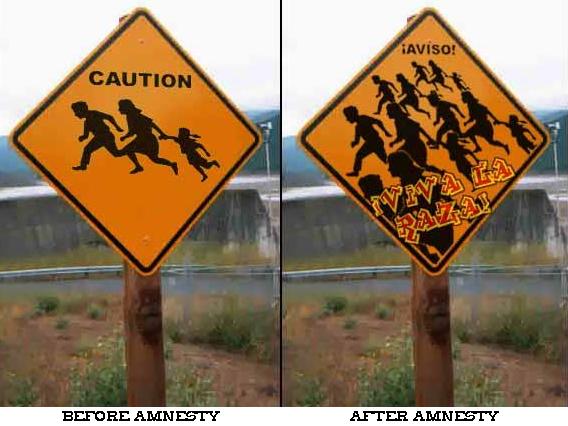
FBI Statistical Report on Illegal Aliens

2006 (1st Qtr) INS/FBI Statistical Report on Illegal Aliens.
If you are a rational human being, you just have to ask yourself WHY we are putting up with this. Can the answer be near the bottom highlighted in red for you? Could some of these trillions be buying the votes of our Senators? Remember, this amount is only for the year 2005.
******************************
Work Paid Under the Table - No Taxes
62% of all "undocumented immigrants" in the United States are working for cash and not paying taxes, predominantly illegal aliens, working without a green card;
Crime
95% of warrants for murder in Los Angeles are for illegal aliens;
83% of warrants for murder in Phoenix are for illegal aliens;
86% of warrants for murder in Albuquerque are for illegal aliens;
75% of people on the most wanted list in Los Angeles, Phoenix, and Albuquerque are illegal aliens;
24.9% of all inmates in California detention centers are Mexican nationals here illegally;
40.1% of all inmates in Arizona detention centers are Mexican nationals here illegally;
48.2% of all inmates in New Mexico detention centers are Mexican nationals here illegally;
29% (630,000) convicted illegal alien felons fill our state and federal prisons at a cost of $1.6 billion annually;
More than 53% of all investigated burglaries reported in California, New Mexico, Nevada, Arizona and Texas are perpetrated by illegal aliens;
More than half of all gang members in Los Angeles are illegal aliens from south of the border;
Car Thefts/ Traffic Violations
More than 71% of all apprehended cars stolen in 2005 in Texas, New Mexico, Arizona, Nevada and California were stolen by illegal aliens or transport coyotes";
47% of cited/stopped drivers in California have no license, no insurance and no registration for the vehicle. Of that 47%, 92% are illegal aliens;
63% of cited/stopped drivers in Arizona have no license, no insurance and no registration for the vehicle. Of that 63%, 97% are illegal aliens;
66% of cited/stopped drivers in New Mexico have no license, no insurance and no registration for the vehicle. Of that 66%, 98% are illegal aliens;
Health Benefits
More than 380,000 "anchor babies" were born in the United States in 2005 were to parents who are illegal aliens; making those 380,000 babies automatically U.S. citizens. 97.2% of all costs concurred from those births were paid by the American taxpayer;
More than 66% of all births in California are to illegal alien Mexicans on Medi-Cal whose births were paid for by taxpayers;
Welfare
More than 43% of all Food Stamps issued are to illegal aliens;
More than 41% of all unemployment checks issued in the United States are to illegal aliens;
58% of all Welfare payments in the United States are issued to illegal aliens;
Nearly 60% of all occupants of HUD properties in the United States are illegal aliens;
More than 300,000 illegal aliens in Los Angeles County are living in garages
Less than 2% of illegal aliens in the United States are picking crops , but 41% are on welfare;
TV and Radio Stations - Spanish Only
14 out of 31 TV stations in L.A. are Spanish-only;
16 out of 28 TV stations in Phoenix are Spanish-only;
15 out of 24 TV stations in Albuquerque are Spanish-only;
21 radio stations in L.A. are Spanish-only;
17 radio stations in Phoenix are Spanish-only;
17 radio stations in Albuquerque are Spanish-only;
Education
More than 34% of Arizona students in grades 1-12 are illegal aliens;
More than 24% of Arizona students in grades 1-12 are non-English-speaking;
More than 39% of California students in grades 1-12 are illegal aliens;
More than 42% of California students in grades 1-12 are non-English-speaking
In Los Angeles County, 5.1 million people speak English. 3.9 million speak Spanish;
Population Growth
Over 70% of the United States annual population growth (and over 90% of California, Florida, and New York) results from immigration; every year to ILLEGAL aliens.
Costs to American Tax Payers
The cost of immigration to the American taxpayer in 1997 (latest know calculation. Can you imagine what it must be in 2006? WOW!) was a NET (after subtracting taxes immigrants pay) $70 BILLION a year, [Professor Donald Huddle, Rice University];
The lifetime fiscal impact (taxes paid minus services used) for the average adult Mexican ILLEGAL alien is $55,000.00 cost to the American taxpayer in a 5-year span. You, personally, are giving $11,000.
Benfit to employers paying less for illegal and paying no taxes - the estimated profit to U.S. corporations and businesses employing ILLEGAL aliens in 2005 was more than $2.6 trillion dollars.
Monday, October 19, 2009
72 years to print a trillion dollars
72 years to print a trillion dollars
 ONE trillion American dollars sounds a lot of cash - and it is.
But did world leaders at the G20 summit really understand the scale of what they were promising when they agreed to spend that amount reviving the world's flagging economy?
Another way of saying one trillion is to think of it as one thousand billion or one million million.
In numbers it is 1,000,000,000,000.
The US Bureau Of Engraving And Printing produces 38million notes a day, so printing one trillion new notes from scratch and working seven days a week would take just over 72 years.
And you would need 429,646 tonnes of ink to complete the job.
Stacked in one pile, one trillion one dollar notes, each 0.0043in thick, would be 67,866 miles high - the same as 12,344 Mount Everests (29,029ft).
Put another way, the stack would be 8.6 times the diameter of the earth, running through the North and South Poles (7,901 miles).
A one dollar note is 6.14in by 2.61in. Stretched end to end, one trillion of them would reach 96,906,566 miles - that's 403 times the distance from Earth to the moon (around 240,000 miles).

Big bucks ... stacked in one pile, one trillion one dollar notes would be 67,866 miles high
If they didn't shrivel in the process, the notes would even go past the sun, which is a mere 92,960,000 miles away. It takes light about eight minutes to travel from the sun to the Earth.
So if you were at one end of the line, looking down a telescope, and there was a greedy banker nicking your notes from the other end, it would be eight minutes and 39 seconds before you could see what he was up to - though you would probably have guessed long before that.
Speaking of greedy bankers, one trillion dollars would pay "Sir" Fred The Shred Goodwin's £703,000 pension (1,040,659 US dollars) for 960,928 years.
If we shared it out fairly, one trillion dollars would give every British man, woman and child £11,073.

If the world's leaders spent the one trillion dollars at the rate of a dollar a second, they would still be spending it in 31,689 years. On the other hand, if they want to get through it all within ten years, they would need to spend 3,169 dollars a second.
The mind-boggling figure from the G20 summit is considerably more dollars than there are in circulation.
According to the US Federal Reserve, there are just 829billion US dollars in existence.
It also costs 6.4 cents to print each note - so it's a good job the massive sum will be passed on electronically.
So rapid is the pace of deficit spending by the federal government, that the National Debt has increased over a trillion dollars since President Obama took office.
On Inauguration Day, the Debt stood at $10.626 trillion. The latest posting from the Treasury Department shows that as of July 31st, the debt hit $11.669 trillion.
During the last administration, it took over 2 ½ years for the National Debt to increase a trillion dollars. But by the time former president George W. Bush left office, he had run up the deficit by a record amount: $4.9-trillion over eight years.
Otherwise there would be a 64billion dollar black hole in the leaders' historic bailout package, which would rather defeat the point.
Read more: http://www.thesun.co.uk/sol/homepage/news/money/article2360477.ece#ixzz0URfcOT3Q
Subscribe to:
Posts (Atom)