Welcome to the American Revolution II

Welcome to the American Revolution II
But when a long train of abuses and usurpations, pursuing invariably the same object evinces a design to reduce them under absolute despotism, it is their right, it is their duty, to throw off such government, and to provide new guards for their future security.
"We face a hostile ideology global in scope, atheistic in character, ruthless in purpose and insidious in method..." and warned about what he saw as unjustified government spending proposals and continued with a warning that "we must guard against the acquisition of unwarranted influence, whether sought or unsought, by the military-industrial complex... The potential for the disastrous rise of misplaced power exists and will persist... Only an alert and knowledgeable citizenry can compel the proper meshing of the huge industrial and military machinery of defense with our peaceful methods and goals, so that security and liberty may prosper together."Dwight D. Eisenhower

Tuesday, June 16, 2009

Bill To Audit Federal Reserve Now Has 209 Co-Sponsors


Steve Watson
Infowars.net
Wednesday, June 10, 2009

Bill To Audit Federal Reserve Now Has 207 Co Sponsors  100609RP

Editor’s note: Ron Paul appeared on the Alex Jones Show today and announced the bill now has 209 sponsors.

At time of writing, a bill that would see the Federal Reserve bank audited for the first time in 59 years has 207 cosponsers in the House and is gaining traction with every single day.

This means just 11 more are needed for a majority to be reached in the House.

If enacted, HR 1207 will amend title 31 of the United States Code and reform the manner in which the Board of Governors of the Federal Reserve System is audited by the Comptroller General of the United States.

In other words, for the first time since 1950, the the independent financial powerhouse that creates and regulates all money in the US will be forced by law to open its books.

HR 1207 was sponsored and introduced by Rep. Ron Paul. On February 26, 2009, it was referred to the House Committee on Financial Services, where it remains under consideration.

HR 1207 also has a companion bill, S 604: F R Sunshine Act of 2009, in the Senate.

This news also dovetails with reports detailing how the House Oversight and Government Reform Committee, the panel responsible for investigating the use of bailout money, has issued a subpoena to the Federal Reserve, asking them to hand over all documents relating to the takeover of Merrill Lynch by the Bank of America.

Claims by New York Attorney-General Andrew Cuomo that former Treasury Secretary Hank Paulson and Federal Reserve Chairman Ben Bernanke strong-armed BofA into buying Merrill, could see the two exposed to prosecution.

There is no doubt that the privately owned Federal Reserve is in hot water, and it knows it.

As we reported last week, the Fed is hiring a veteran lobbyist to “manage its relations with Congress”. According to a Reuters report, the Fed plans to hire Linda Robertson, who previously worked for now-defunct energy company Enron, as well as the Clinton administration.

It is also no coincidence that the End the Fed movement has recently been targeted by smear campaigns. The MIAC report cited Ron Paul supporters as potential extremists and the United States Army Reserve Command issued “mitigation measures” in response to End the Fed demonstrations around the country last year.

Ron Paul recently explained to Forbes why the passage of HR 1207 is so important:

The Federal Reserve’s recent and unprecedented actions in the realm of monetary policy have provoked a backlash among the American people. Trillions of dollars worth of loans and guarantees have been provided to Wall Street firms, while Main Street Americans suffocate under harsh taxation, the prospect of higher debt levels and increasing inflation. These events have awakened many Americans to problems with the Fed’s loose monetary policy, the bubbles it has created in the past and the potential hyperinflation it might cause in the future.

One of the fallacies of modern economics is the idea that a central bank is required in order to keep inflation low and promote economic growth. In reality, it is the central bank’s monetary policy that causes inflation and depresses economic growth. Inflation is an increase in the supply of money, which in our day and age is directly caused or initiated by central banks. All other things being equal, inflation results in a rise in prices. A so-called “mild” rate of inflation of 3% per year leads to a 56% rise in prices over a 15-year period. Even a “low” rate of inflation of 2% per year leads to a 35% rise over that same period. How is that conducive to long-term growth?

A common misconception is that the Fed is completely independent of political pressures. While the Fed has far too much authority to make agreements with foreign governments and central banks, or create temporary liquidity facilities, the governors and–more important–the chairman, are appointed by the president.

If passed, HR1207 will ensure that the Fed make public the destination of the trillions in taxpayer “loans” that have been simply handed over to private banks without oversight.

Bernanke will be seated before Congress and forced to answer these questions instead of worming his way out of them, citing “extraordinary circumstances” and the like, as we have seen him do over and over for the past eight months.

The bill, if it becomes law, will expose how the Fed has consistently engaged the inflation of the currency for the gain of a few elite international bankers, further exposing how this kind of criminal action has directly led to financial crises and recessions for decades.

An audit would set the stage for the end of the Federal Reserve and a return of honest money and fiscal policies.

Indeed, Jim Grant, editor of Grant’s Interest Rate Observer, today told CNBC that the Fed’s balance sheet is “so out of whack” that the central bank would be shut down if subjected to a audit.

“In essence, the bill requires an audit of the Fed’s activity which shall be made available to Congress,” wrote Glenn Greenwald recently. “What possible arguments exist against this bill? Who opposes an audit of the Fed’s activities and why?”

**

Tune in to The Alex Jones Show today (June 10th 2009) to hear Congressman Ron Paul give an update on the progress of HR 1207.

The Daily Paul blog site has compiled a list of Democrats and a list of Republicans who have not signed on to co sponsor HR 1207. If your representatives are in either of these lists, we urge you to contact them and pressure them to cosponser the bill.

A full list of the 207 cosponsers follows. The ever growing list can also be tracked online at the Library of Congress here.

Rep Kagen, Steve [WI-8] - 2/26/2009

Rep Bachmann, Michele [MN-6] - 2/26/2009

Rep Bartlett, Roscoe G. [MD-6] - 2/26/2009

Rep Jones, Walter B., Jr. [NC-3] - 2/26/2009

Rep Rehberg, Denny [MT] - 2/26/2009

Rep Posey, Bill [FL-15] - 2/26/2009

Rep Broun, Paul C. [GA-10] - 2/26/2009

Rep Poe, Ted [TX-2] - 2/26/2009

Rep Burton, Dan [IN-5] - 2/26/2009

Rep Abercrombie, Neil [HI-1] - 2/26/2009

Rep Woolsey, Lynn C. [CA-6] - 2/26/2009

Rep Garrett, Scott [NJ-5] - 3/5/2009

Rep Chaffetz, Jason [UT-3] - 3/6/2009

Rep Kingston, Jack [GA-1] - 3/6/2009

Rep Young, Don [AK] - 3/6/2009

Rep Rohrabacher, Dana [CA-46] - 3/6/2009

Rep Stearns, Cliff [FL-6] - 3/6/2009

Rep McClintock, Tom [CA-4] - 3/6/2009

Rep Heller, Dean [NV-2] - 3/6/2009

Rep Duncan, John J., Jr. [TN-2] - 3/6/2009

Rep Taylor, Gene [MS-4] - 3/6/2009

Rep DeFazio, Peter A. [OR-4] - 3/9/2009

Rep Alexander, Rodney [LA-5] - 3/10/2009

Rep Price, Tom [GA-6] - 3/10/2009

Rep Petri, Thomas E. [WI-6] - 3/10/2009

Rep Foxx, Virginia [NC-5] - 3/10/2009

Rep Grayson, Alan [FL-8] - 3/11/2009

Rep Marchant, Kenny [TX-24] - 3/11/2009

Rep Wamp, Zach [TN-3] - 3/16/2009

Rep Blackburn, Marsha [TN-7] - 3/16/2009

Rep Buchanan, Vern [FL-13] - 3/17/2009

Rep Castle, Michael N. [DE] - 3/17/2009

Rep Fleming, John [LA-4] - 3/18/2009

Rep Akin, W. Todd [MO-2] - 3/19/2009

Rep Platts, Todd Russell [PA-19] - 3/19/2009

Rep Peterson, Collin C. [MN-7] - 3/19/2009

Rep McCotter, Thaddeus G. [MI-11] - 3/19/2009

Rep Lummis, Cynthia M. [WY] - 3/19/2009

Rep Burgess, Michael C. [TX-26] - 3/19/2009

Rep Sessions, Pete [TX-32] - 3/23/2009

Rep Deal, Nathan [GA-9] - 3/23/2009

Rep Franks, Trent [AZ-2] - 3/23/2009

Rep Miller, Jeff [FL-1] - 3/24/2009

Rep Blunt, Roy [MO-7] - 3/24/2009

Rep Stark, Fortney Pete [CA-13] - 3/26/2009

Rep Culberson, John Abney [TX-7] - 3/26/2009

Rep Paulsen, Erik [MN-3] - 3/30/2009

Rep Gingrey, Phil [GA-11] - 3/30/2009

Rep Terry, Lee [NE-2] - 3/30/2009

Rep Carter, John R. [TX-31] - 3/31/2009

Rep Capito, Shelley Moore [WV-2] - 4/1/2009

Rep Wittman, Robert J. [VA-1] - 4/1/2009

Rep Fallin, Mary [OK-5] - 4/2/2009

Rep Smith, Lamar [TX-21] - 4/2/2009

Rep Westmoreland, Lynn A. [GA-3] - 4/2/2009

Rep Lucas, Frank D. [OK-3] - 4/21/2009

Rep Lamborn, Doug [CO-5] - 4/21/2009

Rep Ehlers, Vernon J. [MI-3] - 4/21/2009

Rep Bilbray, Brian P. [CA-50] - 4/21/2009

Rep Pence, Mike [IN-6] - 4/21/2009

Rep Manzullo, Donald A. [IL-16] - 4/21/2009

Rep McCaul, Michael T. [TX-10] - 4/21/2009

Rep Cole, Tom [OK-4] - 4/21/2009

Rep Roe, David P. [TN-1] - 4/21/2009

Rep Herger, Wally [CA-2] - 4/21/2009

Rep Bishop, Rob [UT-1] - 4/21/2009

Rep Baldwin, Tammy [WI-2] - 4/21/2009

Rep Olson, Pete [TX-22] - 4/21/2009

Rep Latham, Tom [IA-4] - 4/21/2009

Rep Luetkemeyer, Blaine [MO-9] - 4/21/2009

Rep Doggett, Lloyd [TX-25] - 4/21/2009

Rep Rooney, Thomas J. [FL-16] - 4/22/2009

Rep Massa, Eric J. J. [NY-29] - 4/22/2009

Rep Johnson, Sam [TX-3] - 4/22/2009

Rep Thompson, Glenn [PA-5] - 4/22/2009

Rep Brady, Kevin [TX-8] - 4/22/2009

Rep Smith, Adam [WA-9] - 4/22/2009

Rep Shimkus, John [IL-19] - 4/22/2009

Rep Graves, Sam [MO-6] - 4/22/2009

Rep Jenkins, Lynn [KS-2] - 4/23/2009

Rep Gohmert, Louie [TX-1] - 4/23/2009

Rep Inglis, Bob [SC-4] - 4/23/2009

Rep Kaptur, Marcy [OH-9] - 4/23/2009

Rep Johnson, Timothy V. [IL-15] - 4/23/2009

Rep Brown, Henry E., Jr. [SC-1] - 4/28/2009

Rep Biggert, Judy [IL-13] - 4/28/2009

Rep Pitts, Joseph R. [PA-16] - 4/28/2009

Rep Tiahrt, Todd [KS-4] - 4/28/2009

Rep Myrick, Sue Wilkins [NC-9] - 4/28/2009

Rep Putnam, Adam H. [FL-12] - 4/28/2009

Rep LaTourette, Steven C. [OH-14] - 4/28/2009

Rep Tiberi, Patrick J. [OH-12] - 4/28/2009

Rep Ros-Lehtinen, Ileana [FL-18] - 4/28/2009

Rep Hoekstra, Peter [MI-2] - 4/28/2009

Rep Miller, Candice S. [MI-10] - 4/28/2009

Rep Granger, Kay [TX-12] - 4/28/2009

Rep Simpson, Michael K. [ID-2] - 4/28/2009

Rep Barrett, J. Gresham [SC-3] - 4/28/2009

Rep Goodlatte, Bob [VA-6] - 4/28/2009

Rep Smith, Adrian [NE-3] - 4/28/2009

Rep Wilson, Joe [SC-2] - 4/29/2009

Rep Hall, Ralph M. [TX-4] - 4/29/2009

Rep Kline, John [MN-2] - 4/29/2009

Rep Bono Mack, Mary [CA-45] - 4/29/2009

Rep Murphy, Tim [PA-18] - 4/29/2009

Rep Calvert, Ken [CA-44] - 4/29/2009

Rep McDermott, Jim [WA-7] - 4/29/2009

Rep Upton, Fred [MI-6] - 4/29/2009

Rep Bachus, Spencer [AL-6] - 4/29/2009

Rep Buyer, Steve [IN-4] - 4/30/2009

Rep Neugebauer, Randy [TX-19] - 4/30/2009

Rep McHenry, Patrick T. [NC-10] - 4/30/2009

Rep McCarthy, Kevin [CA-22] - 5/4/2009

Rep Barton, Joe [TX-6] - 5/4/2009

Rep Hensarling, Jeb [TX-5] - 5/4/2009

Rep McMorris Rodgers, Cathy [WA-5] - 5/4/2009

Rep Bilirakis, Gus M. [FL-9] - 5/4/2009

Rep Moran, Jerry [KS-1] - 5/4/2009

Rep Cassidy, Bill [LA-6] - 5/4/2009

Rep Walden, Greg [OR-2] - 5/4/2009

Rep Crenshaw, Ander [FL-4] - 5/4/2009

Rep Campbell, John [CA-48] - 5/4/2009

Rep LoBiondo, Frank A. [NJ-2] - 5/4/2009

Rep McHugh, John M. [NY-23] - 5/4/2009

Rep Schakowsky, Janice D. [IL-9] - 5/6/2009

Rep Linder, John [GA-7] - 5/6/2009

Rep Aderholt, Robert B. [AL-4] - 5/6/2009

Rep Davis, Geoff [KY-4] - 5/6/2009

Rep Dent, Charles W. [PA-15] - 5/6/2009

Rep Radanovich, George [CA-19] - 5/6/2009

Rep Schock, Aaron [IL-18] - 5/6/2009

Rep Herseth Sandlin, Stephanie [SD] - 5/6/2009

Rep Austria, Steve [OH-7] - 5/6/2009

Rep Adler, John H. [NJ-3] - 5/6/2009

Rep Sensenbrenner, F. James, Jr. [WI-5] - 5/7/2009

Rep Lungren, Daniel E. [CA-3] - 5/7/2009

Rep Walz, Timothy J. [MN-1] - 5/7/2009

Rep Shuster, Bill [PA-9] - 5/7/2009

Rep Michaud, Michael H. [ME-2] - 5/7/2009

Rep Conaway, K. Michael [TX-11] - 5/7/2009

Rep Shadegg, John B. [AZ-3] - 5/7/2009

Rep Boozman, John [AR-3] - 5/7/2009

Rep Guthrie, Brett [KY-2] - 5/7/2009

Rep Flake, Jeff [AZ-6] - 5/11/2009

Rep Hastings, Doc [WA-4] - 5/11/2009

Rep Lance, Leonard [NJ-7] - 5/11/2009

Rep Gerlach, Jim [PA-6] - 5/11/2009

Rep Harper, Gregg [MS-3] - 5/11/2009

Rep Hare, Phil [IL-17] - 5/11/2009

Rep Royce, Edward R. [CA-40] - 5/12/2009

Rep Fortenberry, Jeff [NE-1] - 5/12/2009

Rep Mack, Connie [FL-14] - 5/12/2009

Rep Barrow, John [GA-12] - 5/12/2009

Rep Mica, John L. [FL-7] - 5/12/2009

Rep Maffei, Daniel B. [NY-25] - 5/12/2009

Rep Inslee, Jay [WA-1] - 5/12/2009

Rep Rogers, Mike D. [AL-3] - 5/13/2009

Rep Minnick, Walter [ID-1] - 5/13/2009

Rep Boustany, Charles W., Jr. [LA-7] - 5/13/2009

Rep Turner, Michael R. [OH-3] - 5/13/2009

Rep Hunter, Duncan D. [CA-52] - 5/13/2009

Rep Perriello, Thomas S.P. [VA-5] - 5/13/2009

Rep Ortiz, Solomon P. [TX-27] - 5/14/2009

Rep Ryan, Paul [WI-1] - 5/14/2009

Rep Whitfield, Ed [KY-1] - 5/14/2009

Rep Pastor, Ed [AZ-4] - 5/20/2009

Rep Brown-Waite, Ginny [FL-5] - 5/20/2009

Rep Altmire, Jason [PA-4] - 5/20/2009

Rep Latta, Robert E. [OH-5] - 5/20/2009

Rep Reichert, David G. [WA-8] - 5/20/2009

Rep Rogers, Mike J. [MI-8] - 5/20/2009

Rep Berry, Marion [AR-1] - 5/20/2009

Rep Schauer, Mark H. [MI-7] - 5/20/2009

Rep Scalise, Steve [LA-1] - 5/20/2009

Rep Forbes, J. Randy [VA-4] - 5/20/2009

Rep Ross, Mike [AR-4] - 5/21/2009

Rep Berkley, Shelley [NV-1] - 5/21/2009

Rep Welch, Peter [VT] - 5/21/2009

Rep Thornberry, Mac [TX-13] - 5/21/2009

Rep Jordan, Jim [OH-4] - 6/2/2009

Rep Hinchey, Maurice D. [NY-22] - 6/2/2009

Rep Roskam, Peter J. [IL-6] - 6/2/2009

Rep Young, C.W. Bill [FL-10] - 6/3/2009

Rep Grijalva, Raul M. [AZ-7] - 6/3/2009

Rep Frelinghuysen, Rodney P. [NJ-11] - 6/3/2009

Rep Halvorson, Deborah L. [IL-11] - 6/3/2009

Rep King, Peter T. [NY-3] - 6/4/2009

Rep Holden, Tim [PA-17] - 6/4/2009

Rep Lipinski, Daniel [IL-3] - 6/4/2009

Rep Kratovil, Frank, Jr. [MD-1] - 6/4/2009

Rep Pascrell, Bill, Jr. [NJ-8] - 6/9/2009

Rep Boswell, Leonard L. [IA-3] - 6/9/2009

Rep Bonner, Jo [AL-1] - 6/9/2009

Rep Tonko, Paul D. [NY-21] - 6/9/2009

Rep Mitchell, Harry E. [AZ-5] - 6/9/2009

Rep Johnson, Henry C. “Hank,” Jr. [GA-4] - 6/9/2009

Rep Shea-Porter, Carol [NH-1] - 6/9/2009

Rep Carney, Christopher P. [PA-10] - 6/9/2009

Rep Childers, Travis [MS-1] - 6/9/2009

Rep Murphy, Patrick J. [PA-8] - 6/9/2009

Rep. David Dreier (R-CA)

Rep. Steve King (R-IA)

Rep. John Boehner (R-OH)**

Rep. Ed Perlmutter (D-CO)*

Rep. Chris Lee (R-NY)*

Rep. Mike McIntyre (D-NC)

Rep. Jim McGovern (D-MA)

What is wrong with Obama's Transparency and Open Government

https://blogger.googleusercontent.com/img/b/R29vZ2xl/AVvXsEjUzYlYttUMhSJAljVrqVJS6QZ08mTaRwJXaQX5qFuO-XtpegDgOLLr4ffkZmTnfDuaJqoUtp2sLgUXgckY5nc2K7QDIYgpUstTZjMD1sMWUMKTv4ZACXZU7dUF0DYz1d85pmPzbDCAWhqs/s1600-r/Odeathstar.jpg

MEMORANDUM FOR THE HEADS OF EXECUTIVE DEPARTMENTS AND Obama's Death Star

SUBJECT: Transparency and Open Government
Obama
My Administration is committed to creating an unprecedented level of openness in Government. We will work together to ensure the public trust and establish a system of transparency, public participation, and collaboration. Openness will strengthen our democracy and promote efficiency and effectiveness in Government.
White House
Government should be transparent. Transparency promotes accountability and provides information for citizens about what their Government is doing. Information maintained by the Federal Government is a national asset. My Administration will take appropriate action, consistent with law and policy, to disclose information rapidly in forms that the public can readily find and use. Executive departments and agencies should harness new technologies to put information about their operations and decisions online and readily available to the public. Executive departments and agencies should also solicit public feedback to identify information of greatest use to the public.
Government should be participatory. Public engagement enhances the Government's effectiveness and improves the quality of its decisions. Knowledge is widely dispersed in society, and public officials benefit from having access to that dispersed knowledge. Executive departments and agencies should offer Americans increased opportunities to participate in policymaking and to provide their Government with the benefits of their collective expertise and information. Executive departments and agencies should also solicit public input on how we can increase and improve opportunities for public participation in Government.

http://rasica.files.wordpress.com/2009/05/birt_dees1.jpg
Government should be collaborative
. Collaboration actively engages Americans in the work of their Government. Executive departments and agencies should use innovative tools, methods, and systems to cooperate among themselves, across all levels of Government, and with nonprofit organizations, businesses, and individuals in the private sector. Executive departments and agencies should solicit public feedback to assess and improve their level of collaboration and to identify new opportunities for cooperation.
I direct the Chief Technology Officer, in coordination with the Director of the Office of Management and Budget (OMB) and the Administrator of General Services, to coordinate the development by appropriate executive departments and agencies, within 120 days, of recommendations for an Open Government Directive, to be issued by the Director of OMB, that instructs executive departments and agencies to take specific actions implementing the principles set forth in this memorandum. The independent agencies should comply with the Open Government Directive.
http://8vsb.files.wordpress.com/2009/03/accountability.jpg
This memorandum is not intended to, and does not, create any right or benefit, substantive or procedural, enforceable at law or in equity by a party against the United States, its departments, agencies, or entities, its officers, employees, or agents, or any other person.
This memorandum shall be published in the Federal Register.
BARACK OBAMA

Obama Blocks Visitor List Access were is the Transparency and Open Government

The Obama administration has denied requests from both reporters and government watchdogs to reveal the names of White House guests, echoing Bush administration policy.

reports that their attempt to get visitor logs was denied:

The Obama administration is arguing that the White House visitor logs are presidential records -- not Secret Service agency records, which would be subject to the Freedom of Information Act. The administration ought to be able to hold secret meetings in the White House, "such as an elected official interviewing for an administration position or an ambassador coming for a discussion on issues that would affect international negotiations," said Obama spokesman Ben LaBolt.


These same arguments, made by the Bush administration, were rejected twice by a federal judge. The visitor logs are created by the Secret Service and maintained by the Secret Service, U.S. District Judge Royce Lamberth ruled in 2007 and again this January. CREW had requested records of visits to the Bush White House, as well as the residence of Vice President Dick Cheney, by leaders of Religious Right organizations.

Citizens for Responsibility and Ethics in Washington, a nonpartisan watchdog focused on special interests, was also rebuffed.

CREW sought records of visits by top coal executives in an effort to learn the extent to which these individuals may have influenced the administration's energy policy. Taking the exact same position as the Bush administration, the Obama administration claimed the records are presidential, not agency records, and otherwise exempt in their entirety because of the possibility in some instances they could reveal information protected by the presidential communications privilege. In prior litigation U.S. District Court Judge Royce Lamberth agreed with CREW that the records are agency records that must be disclosed under the FOIA.

The group is filing a complaint against the Department of Homeland Security.

We are deeply disappointed," CREW attorney Anne L. Weismann told MSNBC, "that the Obama administration is following the same anti-transparency policy as the Bush administration when it comes to White House visitor records. Refusing to let the public know who visits the White House is not the action of a pro-transparency, pro-accountability administration."

President Bush fought for years to keep White House visitor logs private, arguing that they should fall under the presidential communications privilege. In January of this year a judge rejected that argument.

Federal Reserve is going to emerge as the big winner in the Obama administration’s

Obama to Limit Fed Lending Power, Grant Systemic Role

By Robert Schmidt and Jesse Westbrook

June 17 (Bloomberg) -- The Obama administration plans to restrict the Federal Reserve’s emergency-lending powers while endowing it with new authority for systemic risk, ushering in what may become the Fed’s biggest overhaul in decades.

President Barack Obama’s proposal on financial regulation, to be released in Washington today, would force the central bank to get written approval from the Treasury secretary before using the authority, according to a copy of the document obtained by Bloomberg News. Obama also calls for a study of the Fed’s governance structure, including how it regulates financial firms.

The move is part of a proposal that would alter almost every facet of federal rules for the industry, aiming to prevent the regulatory lapses and build-up of risks that led to the worst crisis since the Great Depression. Much of the plan will require approval in Congress, where jurisdictional battles and ideological clashes may delay and alter the legislation. Obama aims to sign a bill by the end of the year.

“We have to have somebody who is responsible for seeing the risks of the system as a whole and not just individual institutions,” Obama said yesterday in an interview with Bloomberg News, referring to making the Fed the systemic risk regulator. “The Fed is best positioned to do that.”

New Agency

A new agency would oversee consumer financial products, such as mortgages and credit cards. The proposal, much of which has been reported earlier, encompasses areas ranging from derivatives to executive pay to the mortgage-backed securities that helped fuel the housing boom and touch off the credit crisis. It also requests federal oversight for the first time for hedge and private equity funds.

The Treasury and outside experts “should have substantial input into the review and the resulting report” on the Fed’s governance study, according to the paper. The Treasury can propose changes to the central bank’s structure “to improve its accountability and its capacity to achieve its statutory responsibilities.”

Obama said changes are needed to restore confidence in U.S. markets. “We now need some sensible rules of the road so that people aren’t taking exorbitant risks,” he said.

The overhaul comes on the heels of the credit crisis, the collapse of major Wall Street firms like Bear Stearns Cos. and the government’s $700 billion bailout for the banking, auto and insurance industries.

Extra Capital

“While this crisis has had many causes, it is clear now that the government could have done more to prevent many of these problems from growing out of control and threatening the stability of the financial system,” Obama’s administration says in the document.

Investment banks “operated with insufficient government oversight” while hedge funds exist “completely outside of the supervisory framework,” according to the paper.

The administration is seeking to require firms that pose the biggest risk to the financial system to hold extra capital. It proposes those levels should be determined by Dec. 31. It asks for a committee, led by the Treasury, to do a “fundamental reassessment” of how banks are supervised by Oct. 1.

The administration downplayed reining in the Fed’s emergency powers, and said the central bank sought and received the Treasury secretary’s approval for lending during the crisis.

The administration called for a national insurance office within the Treasury to gather information about the industry and try to identify gaps in regulation that “could contribute to a future crisis,” according to the plan.

Insurance Industry

The office will also make recommendations to the Fed on whether it should regulate individual insurance companies as systemically important, subjecting them to capital and leverage requirements.

The proposal follows multiple government bailouts of American International Group Inc., once the world’s largest insurer before losses on derivative contracts put the company on the brink of collapse. It stops short of recommending federal regulation of insurance companies, which are overseen by states.

Additional insurance regulation would be considered if it would “further reduce systemic risk,” according to the paper.

The administration plans to offer recommendations on housing-finance companies Fannie Mae and Freddie Mac, which were effectively seized by the government last year, by the time the 2011 federal budget is released.

‘Continued Stability’

“We need to maintain the continued stability and strength” of the companies “during these difficult financial times,” the paper says.

The Obama proposal calls on the Securities and Exchange Commission to make brokerage firms fiduciaries to their clients. Such a standard, which already applies to money managers, would require brokers to put their customers’ interests above the firm’s in securities transactions.

Obama would tie compensation for market participants who securitize loans to the performance of the assets over time, according to the document. The pay for brokers, underwriters and others who package mortgages into bonds “should be linked to the longer-term performance of the securitized assets, rather than only to the production, creation or inception of those products,” the paper says.


Commentaries

Now raising intellectual capital


June 15th, 2009

Who is the Fed accountable to?

Posted by: Matthew Goldstein

It’s pretty clear the Federal Reserve is going to emerge as the big winner in the Obama administration’s proposed overhaul of the financial regulatory system. But any grant of new powers to the Fed must come with legislation requiring greater accountabilty from the nation’s central banker.

Now this is not meant to knock the job the Fed has done in the current financial crisis. In many respects, Fed Chairman Ben Bernanke should be applauded for showing a willingness to improvise and come up with creative solutions for trying to limit the damage to the banking system and the economy. But throughout the crisis, Benanke & Co. have shown an utter disdain for transparency and full disclosure.

A good illustration of this is the contracts the NY Fed signed last fall with investment advisor Blackrock to manage the distressed assets the Fed acquired from AIG, the hobbled insurance giant. The contract between the NY Fed and Blackrock for managing the CDOs that AIG insured and the Fed took off the banks’ hands is 37 pages. But a good number of those pages are blank–some 13 page to be exact.

And what is spelled out on these blank pages? Oh, just a few minor details like the fees paid to Blackrock, the firm’s potential CDO conflicts and the firm’s key personnel managing the assets. To be clear, this information isn’t totally secret. All this information has been disclosed to the NY Fed. It’s just that Fed officials have seen fit to keep this information secret from the public.

But if you’re counting on this veil of secrecy to be lifted by the Obama administration when it unveils its regulatory overhaul plan on Wednesday—think again. The architect of the financial regulatory overhaul is Treasury Secretary Tim Geithner, who just happened to head the NY Fed when these contracts with Blackrock were signed.

As I pointed out last week, Geithner hasn’t shown much interest in the need for government transparency in his new job. Treasury, in agreeing to let 10 banks repay money to the TARP, couldn’t even name the list of financial institutions.

Financial regulatory overhaul won’t mean much unless the general public and investors get more information about the inner workings of the financial institutions the government is seeking to better control. And the new regulations won’t inspire much confidence, if the public doesn’t feel the regulators are also being held to account.

American Is Bankrupt

American Is Bankrupt

http://www.truthdig.com/report/item/20090614_the_american_empire_is_bankrupt/

Jun 14, 2009

By Chris Hedges

http://www.truthdig.com/images/eartothegrounduploads/800px-Dollarnote_hq30.jpg

This week marks the end of the dollar’s reign as the world’s reserve currency. It marks the start of a terrible period of economic and political decline in the United States. And it signals the last gasp of the American imperium. That’s over. It is not coming back. And what is to come will be very, very painful.

Barack Obama, and the criminal class on Wall Street, aided by a corporate media that continues to peddle fatuous gossip and trash talk as news while we endure the greatest economic crisis in our history, may have fooled us, but the rest of the world knows we are bankrupt. And these nations are damned if they are going to continue to prop up an inflated dollar and sustain the massive federal budget deficits, swollen to over $2 trillion, which fund America’s imperial expansion in Eurasia and our system of casino capitalism. They have us by the throat. They are about to squeeze.

There are meetings being held Monday and Tuesday in Yekaterinburg, Russia, (formerly Sverdlovsk) among Chinese President Hu Jintao, Russian President Dmitry Medvedev and other top officials of the six-nation Shanghai Cooperation Organization. The United States, which asked to attend, was denied admittance. Watch what happens there carefully. The gathering is, in the words of economist Michael Hudson, “the most important meeting of the 21st century so far.”

http://informedatonce.files.wordpress.com/2008/01/dollardees-4web.jpg

It is the first formal step by our major trading partners to replace the dollar as the world’s reserve currency. If they succeed, the dollar will dramatically plummet in value, the cost of imports, including oil, will skyrocket, interest rates will climb and jobs will hemorrhage at a rate that will make the last few months look like boom times. State and federal services will be reduced or shut down for lack of funds. The United States will begin to resemble the Weimar Republic or Zimbabwe. Obama, endowed by many with the qualities of a savior, will suddenly look pitiful, inept and weak. And the rage that has kindled a handful of shootings and hate crimes in the past few weeks will engulf vast segments of a disenfranchised and bewildered working and middle class. The people of this class will demand vengeance, radical change, order and moral renewal, which an array of proto-fascists, from the Christian right to the goons who disseminate hate talk on Fox News, will assure the country they will impose.

I called Hudson, who has an article in Monday’s Financial Times called “The Yekaterinburg Turning Point: De-Dollarization and the Ending of America’s Financial-Military Hegemony.” “Yekaterinburg,” Hudson writes, “may become known not only as the death place of the czars but of the American empire as well.” His article is worth reading, along with John Lanchester’s disturbing exposé of the world’s banking system, titled “It’s Finished,” which appeared in the May 28 issue of the London Review of Books.

“This means the end of the dollar,” Hudson told me. “It means China, Russia, India, Pakistan, Iran are forming an official financial and military area to get America out of Eurasia. The balance-of-payments deficit is mainly military in nature. Half of America’s discretionary spending is military. The deficit ends up in the hands of foreign banks, central banks. They don’t have any choice but to recycle the money to buy U.S. government debt. The Asian countries have been financing their own military encirclement. They have been forced to accept dollars that have no chance of being repaid. They are paying for America’s military aggression against them. They want to get rid of this.”

http://blog.joshgalt.com/images/2008/10/02/newdollar.jpg

China, as Hudson points out, has already struck bilateral trade deals with Brazil and Malaysia to denominate their trade in China’s yuan rather than the dollar, pound or euro. Russia promises to begin trading in the ruble and local currencies. The governor of China’s central bank has openly called for the abandonment of the dollar as reserve currency, suggesting in its place the use of the International Monetary Fund’s Special Drawing Rights. What the new system will be remains unclear, but the flight from the dollar has clearly begun. The goal, in the words of the Russian president, is to build a “multipolar world order” which will break the economic and, by extension, military domination by the United States. China is frantically spending its dollar reserves to buy factories and property around the globe so it can unload its U.S. currency. This is why Aluminum Corp. of China made so many major concessions in the failed attempt to salvage its $19.5 billion alliance with the Rio Tinto mining concern in Australia. It desperately needs to shed its dollars.

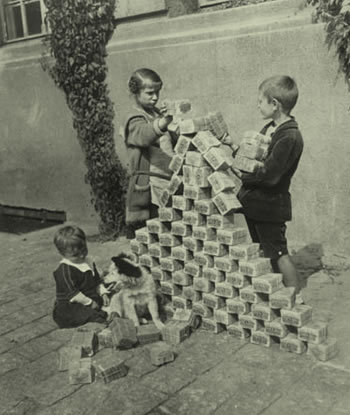
German Children Playing With Money

“China is trying to get rid of all the dollars they can in a trash-for-resource deal,” Hudson said. “They will give the dollars to countries willing to sell off their resources since America refuses to sell any of its high-tech industries, even Unocal, to the yellow peril. It realizes these dollars are going to be worthless pretty quickly.”

The architects of this new global exchange realize that if they break the dollar they also break America’s military domination. Our military spending cannot be sustained without this cycle of heavy borrowing. The official U.S. defense budget for fiscal year 2008 is $623 billion, before we add on things like nuclear research. The next closest national military budget is China’s, at $65 billion, according to the Central Intelligence Agency.

There are three categories of the balance-of-payment deficits. America imports more than it exports. This is trade. Wall Street and American corporations buy up foreign companies. This is capital movement. The third and most important balance-of-payment deficit for the past 50 years has been Pentagon spending abroad. It is primarily military spending that has been responsible for the balance-of-payments deficit for the last five decades. Look at table five in the Balance of Payments Report, published in the Survey of Current Business quarterly, and check under military spending. There you can see the deficit.

To fund our permanent war economy, we have been flooding the world with dollars. The foreign recipients turn the dollars over to their central banks for local currency. The central banks then have a problem. If a central bank does not spend the money in the United States then the exchange rate against the dollar will go up. This will penalize exporters. This has allowed America to print money without restraint to buy imports and foreign companies, fund our military expansion and ensure that foreign nations like China continue to buy our treasury bonds. This cycle appears now to be over. Once the dollar cannot flood central banks and no one buys our treasury bonds, our empire collapses. The profligate spending on the military, some $1 trillion when everything is counted, will be unsustainable.

http://www.vtocity.com/vtogallery/main.php?g2_view=core.DownloadItem&g2_itemId=3257&g2_serialNumber=1

“We will have to finance our own military spending,” Hudson warned, “and the only way to do this will be to sharply cut back wage rates. The class war is back in business. Wall Street understands that. This is why it had Bush and Obama give it $10 trillion in a huge rip-off so it can have enough money to survive.”

The desperate effort to borrow our way out of financial collapse has promoted a level of state intervention unseen since World War II. It has also led us into uncharted territory.

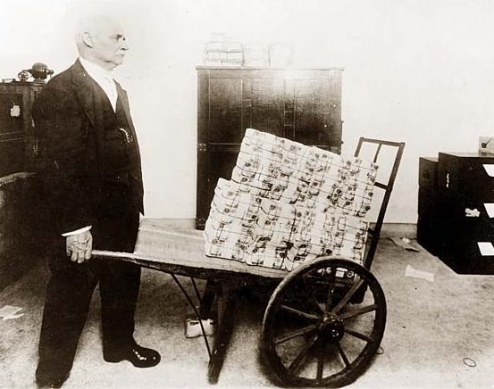
Wheelbarrow of Worthless Money

“We have in effect had to declare war to get us out of the hole created by our economic system,” Lanchester wrote in the London Review of Books. “There is no model or precedent for this, and no way to argue that it’s all right really, because under such-and-such a model of capitalism ... there is no such model. It isn’t supposed to work like this, and there is no road-map for what’s happened.”

The cost of daily living, from buying food to getting medical care, will become difficult for all but a few as the dollar plunges. States and cities will see their pension funds drained and finally shut down. The government will be forced to sell off infrastructure, including roads and transport, to private corporations. We will be increasingly charged by privatized utilities—think Enron—for what was once regulated and subsidized. Commercial and private real estate will be worth less than half its current value. The negative equity that already plagues 25 percent of American homes will expand to include nearly all property owners. It will be difficult to borrow and impossible to sell real estate unless we accept massive losses. There will be block after block of empty stores and boarded-up houses. Foreclosures will be epidemic. There will be long lines at soup kitchens and many, many homeless. Our corporate-controlled media, already banal and trivial, will work overtime to anesthetize us with useless gossip, spectacles, sex, gratuitous violence, fear and tawdry junk politics. America will be composed of a large dispossessed underclass and a tiny empowered oligarchy that will run a ruthless and brutal system of neo-feudalism from secure compounds. Those who resist will be silenced, many by force. We will pay a terrible price, and we will pay this price soon, for the gross malfeasance of our power elite.

http://2.bp.blogspot.com/_nldFQlUV7Lc/SZF49fMRq2I/AAAAAAAABig/SyaJhOaBO4U/s400/Dollar_Obama_ThankYouSucker.gif

YEKATERINBURG, Russia – Brazil, Russia, India and China say the world needs a more diversified international monetary system.

The four so-called BRIC nations are concluding their first summit with a final statement calling for the reform of global financial institutions to reflect changes in world economy.

They said Tuesday there is a strong need for a stable, predictable and more diversified global monetary system and urged support for a more democratic and just "multipolar" world order.

There was no explicit mention of the U.S. dollar or the United States in the statement.

THIS IS A BREAKING NEWS UPDATE. Check back soon for further information. AP's earlier story is below.

YEKATERINBURG, Russia (AP) _ China and Russia sought greater international clout at a summit Tuesday, with China promising $10 billion in loans to Central Asian countries and Russia challenging the U.S. dollar's dominance as a global reserve currency.

Chinese leader Hu Jintao said China will offer the loans to several countries, including Russia, Kazakhstan, Kyrgyzstan, Tajikistan and Uzbekistan, to help them through the global financial crisis.

The move, announced at the meeting of the Shanghai Cooperation Organization, adds muscle to China's role in the group, which Russia and China use to counter Western influence in resource-rich, strategically placed Central Asia.

The leaders of Afghanistan, Iran, India and Pakistan were also at the table, underscoring Russia and China's reach for broader global influence. The Shanghai group members released a summit declaration saying that global "multi-polarity is irreversible," a reference to their opposition to perceived U.S. domination in international affairs.

Russia gave a prominent platform to newly re-elected Iranian President Mahmoud Ahmadinejad, a show of support for a leader facing major protests at home and questions from the West about the legitimacy of the vote count.

Russian President Dmitry Medvedev sought to further raise his country's leverage in geopolitical issues by separately meeting with Afghan and Pakistani leaders late Monday to discuss the stabilization of Afghanistan.

Medvedev said Russia offered help in carrying out joint transport, energy and other economic projects in the region to help eradicate poverty and remove feeding grounds for terrorism.

Russia signaled its intention to offer stronger assistance to the U.S.-led efforts in Afghanistan. Russia will continue to cooperate with the U.S.-led coalition there and provide transit corridors for supplies, but no new initiatives were announced.

At the same time, Medvedev pushed against U.S. domination of financial markets by calling for new global reserve currencies to complement the dollar.

"No currency system can be successful if we have financial instruments denominated in just one currency," Medvedev said. "We must strengthen the international financial system not only by making the dollar strong, but also by creating other reserve currencies."

Medvedev said new currencies will take a long time to emerge, but emphasized that the world will feel the growing need to hedge financial risks. "The main reserve currency, the dollar, has failed to serve its purpose," he said.

http://www.guzer.com/pictures/money-tp.jpg

After wrapping up the two-day Shanghai Cooperation Organization meetings, Medvedev was to host later Tuesday the first full-fledged summit of emerging economies Brazil, Russia, India and China, collectively called BRIC.

Medvedev's economic adviser Arkady Dvorkovich said Russia may diversify its currency reserves investments by buying bonds issued by Brazil, China and India. He told a briefing that Russia could make the move if the other three BRIC members reciprocate.

Dvorkovich also proposed revising the way the International Monetary Fund's obligations are valued. He said the ruble, the yuan and gold should be part of a revised basket of currencies to form the valuation of the IMF's special drawing rights (SDRs), international reserve assets that supplement countries' existing official reserves.

Dvorkovich denied any rift on the issue with Russian Finance Minister Alexei Kudrin, who this week helped the dollar rebound in value by saying over the weekend that the dollar's status as the world's main reserve currency wasn't likely to change soon.

https://blogger.googleusercontent.com/img/b/R29vZ2xl/AVvXsEhcw_m5UmVqk9NGrT72Bcefcc6TjwJGRlrEzHJnkh25xP27i9mwNog3zdMVtiO2tl0uGSFFVOEfCDmhGkkt_1o3SZHl5gB6_6BsbNaM4yv-3CGy61JdMFWyzSyCM8Gcshi2hDE3kPWf3byU/s400/worthless_color+USD.jpg

"No one wants to bring the dollar down," he said.

He added, however, that the creation of new reserve currencies should help distribute global wealth more fairly and also encourage economic leaders to pursue a more balanced economic policy.

The talk about global reserve currencies has been prompted by concerns in China and Russia that soaring U.S. budget deficits could spur inflation and weaken the dollar, debasing the value of their holdings.

"Those who issue reserve currencies today don't always take the interests of the global economy into account," Dvorkovich said

Officials from Russia, China and Brazil have said in recent weeks that they would invest in bonds issued by the International Monetary Fund to diversify their dollar-heavy currency reserves.

China is Washington's biggest foreign creditor, holding an estimated $1 trillion in U.S. government debt. But the Treasury Department this week said foreigners _ including China and Japan, the two biggest buyers of U.S. government debt _ had trimmed their Treasury holdings in April.

Russia's Deputy Foreign Minister Sergei Ryabkov said that the BRIC summit was "not an attempt to compete with anyone."

While BRIC members share a desire to play a bigger role in creating a new global financial order and counterbalancing the West and Japan, their often contradictory interests would make forging a common policy a difficult task.

China and India have sizable labor resources, while Russia and Brazil are rich in natural resources. China is a major consumer of natural resources, unlike Russia and Brazil, which are top producers. While China wants lower oil prices, Russia and Brazil would seek higher oil prices.

[Dollar_Obama_ThankYouSucker.gif]

Monday, June 15, 2009

Dick Cheney Leon Panetta Robert Gibbs Nancy Pelosi


http://toxicculture.files.wordpress.com/2008/10/dick-cheney.jpg

Dick Cheney says he wants to know if he heard Leon Panetta correctly.

After the CIA director apparently told The New Yorker that he thinks the former vice president is crossing his fingers for another attack on America, Cheney said Monday he hopes his "old friend" didn't really say those words.

"I hope my old friend Leon was misquoted," Cheney said, in a written statement to FOX News. "The important thing is whether the Obama administration will continue the policies that have kept us safe for the past eight years."

http://www3.pictures.gi.zimbio.com/Ceremonial+Swearing+Leon+Panetta+Held+CIA+9zDp_BnzyRpl.jpg

Others were not quite willing to give Panetta the benefit of the doubt, as his politically charged quote stirred controversy on Capitol Hill.

Sen. John McCain, R-Ariz., called on Panetta to "retract immediately" his statement, arguing that the director crossed the line.

http://www.babble.com/CS/blogs/famecrawler/2008/11/01-07/john_mccain_thumbs_up.jpg

"I disagreed with the Cheney policy on interrogation techniques, but never did it cross my mind that Dick Cheney would ever want an attack on the United States of America," the former GOP presidential candidate told FOX News Monday. "And it's unfair, and I think that Mr. Panetta should retract, and retract immediately.

"By the way, I hear morale is not at an all-time high over at the CIA under Mr. Panetta's leadership," he said.

Panetta, a long-time Washington insider with scant intelligence experience, has been caught in the middle of a political war during his first few months on the job. First, he had to deal with morale issues as President Obama cracked down on the rules for http://cinie.files.wordpress.com/2008/08/nancy_pelosi.jpg

detainee interrogations. Then he stepped up to dispute House Speaker Nancy Pelosi's allegation that the CIA misled Congress about the use of "enhanced" interrogation techniques.

This time, he's firing back against Cheney's frequent media appearances in which he's accused Obama of making America less safe.

According to The New Yorker, Panetta said Cheney "smells some blood in the water" on the security issue.

"It's almost, a little bit, gallows politics. When you read behind it, it's almost as if he's wishing that this country would be attacked again, in order to make his point. I think that's dangerous politics," he said, according to the piece.

http://www.swamppolitics.com/news/politics/blog/2009/01/23/Robert%20Gibbs%20at%20the%20podium.jpg

Asked about the statement, White House Press Secretary Robert Gibbs ducked.

"I'm not going to get into motivations. That's not what our business is. The president's concern is keeping the American people safe," Gibbs said Monday.

The Four Horsemen of the Apocalypse

Dick Cheney Leon Panetta Robert Gibbs Nancy Pelosi

http://2012connection.files.wordpress.com/2009/01/apocalypse-horsemen.jpg

Sunday, June 14, 2009

Giving the Fed more clout

[Barack Obama]

WASHINGTON -- President Barack Obama is expected Wednesday to propose the most sweeping reorganization of financial-market supervision since the 1930s, a revamp that would touch almost every corner of banking from how mortgages are underwritten to the way exotic financial instruments are traded.

At the center of the plan, which administration officials are referring to as a "white paper," is a move to remake powers of the Federal Reserve to oversee the biggest financial players, give the government the power to unwind and break up systemically important companies -- much like the Federal Deposit Insurance Corp. does with failed banks -- and create a new regulator for consumer-oriented financial products, according to people involved in the process.

The plan stops short of the complete consolidation of power that some lawmakers have advocated. For example, it will allow several agencies to continue supervising banks. It also won't place specific limits on the size or scope of financial institutions, but it will make it much harder for large companies to be so overleveraged that they threaten the broader economy.

After Mr. Obama details his proposal, the process will quickly move to Capitol Hill, where Congress would have to pass legislation to enact the changes. Treasury Secretary Timothy Geithner is scheduled to appear before both Senate and House panels on Thursday, where he is likely to face questions and criticisms.

Lawmakers are expected to take issue with several of the plan's more thorny issues, including how to create a system that won't simply bail out large financial companies when they topple. Giving the Fed more clout -- in light of recent criticism from lawmakers, both Republican and Democratic, of its secrecy and accumulation of power -- will also be a controversial idea.

Democrats in Congress could push for more consumer-protection powers and stricter limits on executive compensation than administration officials want. And bureaucratic turf wars could emerge as some authorities are reapportioned.

Administration officials say their goal is to make it less likely the economy will ever again teeter on the brink of collapse by giving policy makers more tools to arrest a crisis the next time one occurs.

They envision a less volatile financial marketplace where banks are encouraged, through tougher capital, liquidity and leverage requirements, to take fewer risks that have the potential to destabilize the economy. Hedge funds would be forced to register with the government and may face federal supervision if they are large and complex enough. Mortgages and other consumer products would be monitored by a new watchdog, and there would be global transparency rules over exotic financial instruments.

"Considerations of stability, safety and systemic risk have to loom larger in the planning, thinking, and strategizing of every financial institution going forward than they have in the past," White House National Economic Council Director Lawrence Summers said in a speech on Friday.

http://justgetthere.us/blog/uploads/Fiat-Empire.jpg

www.apfn.org/apfn/reserve.htm

The proposal won't sweep away the confusing and sometimes overlapping patchwork of state and federal supervisors that often clash over jurisdiction. Critics say institutions have been shopping around for the regulator with the lightest touch and that systemwide problems fell through the cracks.

In fact, the proposal could lead to the abolishment of just one agency -- the Office of Thrift Supervision. With the proposed new consumer agency, the number of agencies overseeing finance would remain unchanged.

Officials say the goal is to distribute power in such a way that gaps in oversight are removed and the opportunities for regulator shopping reduced.

Policy makers have pushed sweeping changes over the regulation of financial markets before with mixed results. In March 2008, then Treasury Secretary Henry Paulson proposed an overhaul of supervision, but Congress didn't take up the ideas.

Other efforts have had unintended consequences. The Clinton administration won legislation that broke down Depression-era barriers between commercial banking, investment banking and insurance, among other things. Mr. Obama has criticized that law for helping create some of the financial behemoths that threatened the economy last year.

The current White House, which made the revamp a centerpiece of its early months in office, is keen to move fast. "Experience teaches that once the crisis has passed, the will to reform will pass as well," Mr. Summers said in his speech.

The plan calls on the Fed to oversee financial institutions, products, or practices that could pose a systemic risk to the economy. It will create a "council" of regulators to monitor this area as well. Government officials believe this arrangement will forestall companies from growing large and overleveraged without substantial federal supervision, as happened, for example, in the case of giant insurer American International Group Inc.

The Fed will likely have the power to set capital and liquidity requirements for the U.S.'s largest financial companies and scour the books of a wide range of firms. It is unclear what enforcement powers the central bank will have; that likely will be a point of contention as lawmakers debate the issue.

How the Fed interacts with this council also will be a subject of debate. Administration officials envision the council being able to recommend that a specific company, product or practice be subject to Fed supervision, with the central bank ultimately accountable for each area or company that poses the systemic risk. This could set up clashes between the Fed and the council, especially if one is more hawkish than the other.

The goal is to avoid repeating a situation akin to the collapse of Lehman Brothers Holdings Inc., where the government had no authority to smoothly unwind the failing institution. A step such as this is expected to be exercised only rarely, and it could first require approval by the Treasury Department, Federal Reserve, and FDIC, people familiar with the process said. Once a company is placed into receivership, the process will likely be run by the FDIC. It is unclear how such a program will be financed.

On some potentially divisive issues, the administration tried to find a delicate balance, people familiar with the process said. For example, it won't call for the Securities and Exchange Commission to merge with the Commodity Futures Trading Commission, being unwilling to expend political capital on the battles with congressional fiefdoms that this move would spark.

But the proposal will push for much more "harmonization" between these two agencies. There has long been tension between them because many of the companies overseen by the SEC trade derivatives and other products regulated by the CFTC.

The new regulator overseeing consumer protection is expected to take some areas that once belonged to the Fed -- such as credit cards and mortgages -- but isn't expected to siphon off supervision of investment products such as mutual funds from the SEC.

Mr. Obama will call for several requirements to be adopted globally, such as tougher capital requirements for the largest financial institutions and the power to wind down large, globally interconnected banks. Administration officials also are calling for more transparency over complex derivatives that are traded by large, multinational companies.

"Risk and leverage will always tend to migrate to where the constraints are weakest," Mr. Geithner said Saturday after a meeting in Italy of finance ministers from the Group of Eight major powers. "We need a level playing field globally, or the effectiveness of our national safeguards against risk will be undermined."

House Financial Services Committee Chairman Barney Frank (D., Mass.) is expected to take up the measure on Capitol Hill soon and could have a comprehensive package passed by August. Senate Banking Committee Chairman Christopher Dodd (D., Conn.) said his panel could hold votes in the fall with a final measure completed by the end of the year. That is consistent with the administration's timetable.

Write to Damian Paletta at damian.paletta@wsj.com

U.S. special operations leader takes Afghan command

Gen. Stanley McChrystal takes command of NATO, U.S. forces in Afghanistan

by Jason Straziuso / Associated Press
Monday June 15, 2009, 3:17 AM

Gen. Stanley McChrystal, a former commanding general of the Joint Special Operations Command, is now in charge in Afghanistan.

KABUL -- Gen. Stanley McChrystal, a four-star American general with a long history in special operations, took charge of U.S. and NATO troops in Afghanistan today, a change of command the Pentagon hopes will turn the tide in an increasingly violent eight-year war.

McChrystal took command from Gen. David McKiernan during a low-key ceremony at the heavily fortified headquarters of the NATO-led International Security Assistance Force in central Kabul. McKiernan was fired last month by Defense Secretary Robert Gates one year into a two-year assignment.

McChrystal, a former commanding general of the Joint Special Operations Command, is expected to bring a more unconventional approach to a war that has turned increasingly violent the past three years.

"The Afghan people are at the center of our mission. In reality, they are the mission. We must protect them from violence, whatever its nature. We must respect their religion and traditions," McChrystal said. "But while operating with care, we will not be timid."

McChrystal will command the largest international force ever in Afghanistan. A record 56,000 U.S. troops are in the country, alongside 32,000 forces from 41 other countries.

American troops have poured into Helmand province the last several weeks in an effort to stamp out an insurgency that has a strong hold in the world's largest opium-poppy growing region.

McChrystal met with President Hamid Karzai on Sunday, who warned the American general that the "most important element of the mission" is to protect Afghan civilians.

Civilian casualties during military operations have long been a point of friction between Karzai and the U.S. The most contentious examples of civilian deaths in U.S. military operations in recent years have involved U.S. Special Operations Forces, which McChrystal used to command.

The four-star general has already pledged to reduce the number of Afghan villagers killed in fighting, saying he intends to review U.S. and allied operating procedures with an eye to minimizing civilian deaths.

"Although I expect stiff fighting ahead, the measure of effectiveness will not be enemy killed. It will be the number of Afghans shielded from violence," he said during testimony before Congress this month.

He also said that if he could obtain more intelligence, surveillance and reconnaissance aircraft, it would sharpen the precision of allied attacks, thereby avoiding unwanted casualties.

Militant attacks have risen steadily in the last three years and have reached a new high. U.S. Gen. David Petraeus said Afghanistan saw 400 insurgent attacks during the first week of June. In comparison, there were less than 50 attacks per week in January 2004. By Jonathon Burch and Peter Graff
Reuters
Monday, June 15, 2009; 2:04 AM

KABUL (Reuters) - A veteran commander of top-secret special operations takes charge of the nearly 90,000 U.S. and NATO troops in Afghanistan Monday, promising to limit the civilian deaths that have cost Western troops Afghan support.

General Stanley McChrystal arrived in Afghanistan on Sunday, a month after being named by President Barack Obama to succeed General David McKiernan, abruptly removed last month from command of a war U.S. officials say is not being won.

"The measure of effectiveness will not be (the number of) enemy killed, it will be the number of Afghans shielded from violence," NATO quoted McChrystal as saying in a statement.

After his arrival, McChrystal met Afghan President Hamid Karzai, who pressed him to avoid civilian casualties, Karzai's office said.

Civilian deaths by foreign troops while hunting the militants, nearly eight years on since the Taliban's ouster, have angered many Afghans and have been the main source of friction between Karzai's government and the United States.

It is an issue both sides have been stressing, especially since a U.S. air strike in May that the Afghan government says killed 140 civilians, mostly children.

Washington acknowledges mistakes in that strike and says 20-35 civilians died along with about 60 people it believes were fighters.

Washington considers Taliban-led insurgencies in Afghanistan and neighboring Pakistan to be its main security threat, and has begun diverting tens of thousands of troops to Afghanistan from Iraq.

McChrystal takes command midway through a massive build-up of U.S. forces that will see their numbers more than double from 32,000 at the end of 2008 to an anticipated 68,000 by the end of this year.

He also commands about 30,000 troops from other NATO allies.

U.S. forces say the number of insurgent attacks in Afghanistan is at its highest since the militants were driven out of power in retaliation for shielding Osama bin Laden after the September 11 attacks on the United States.

Fighting is expected to intensify over the next months as more U.S. and NATO troops deploy ahead of an August presidential election.

McChrystal's background has raised some eyebrows: for most of the last six years he led a cadre of super-secret U.S. special forces raiders in both Iraq and Afghanistan, tasked mainly with locating, capturing and assassinating insurgent leaders.

Much of his career is classified, and an official biography released by NATO leaves out many details.

But in an interview with the Wall Street Journal this month, he said he had learned that targeted killings, like those he has carried out for much of his recent career, were not enough to defeat an insurgency.

"Since 9/11, I have watched as America tried to first put out this fire with a hammer, and it doesn't work," he said. "Decapitation strategies don't work."

"You're going to have to convince people, not kill them."